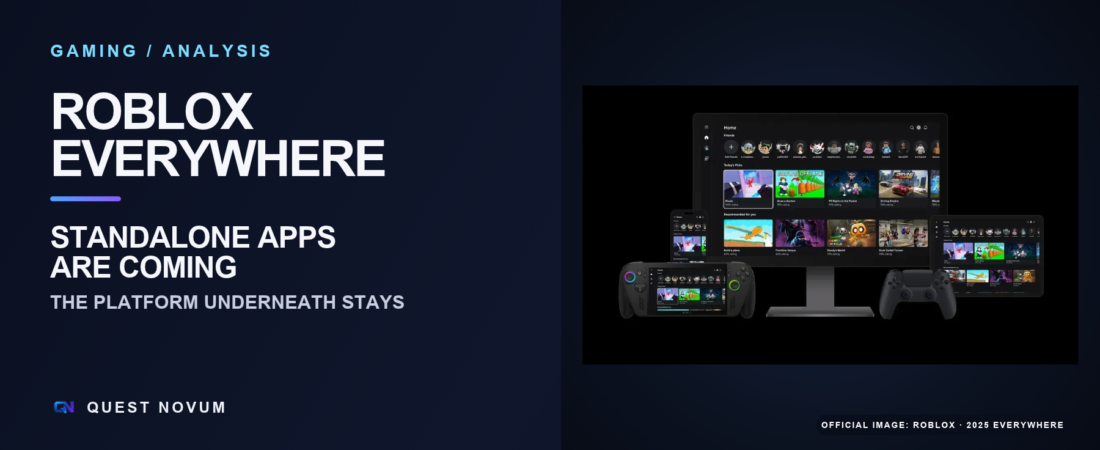
Roblox Everywhere will let creators release standalone apps across mobile, PC and consoles, while browser play removes the install step. That looks less like abandoning Roblox and more like unbundling its client from the technology underneath.
For most players, a Roblox game has always meant opening Roblox first.
That assumption is starting to loosen.
At RDC 2026, Roblox announced that creators will be able to make their games available as standalone apps across mobile, PC and consoles. By the end of 2026, players will also be able to open a game’s Experience Details page in Chrome and start playing without installing the Roblox app. Additional browsers are planned later, while offline solo play is due to follow next year.
None of that means creators are leaving Roblox.
The company is explicit that Roblox will continue powering the technology and services underneath those standalone apps. What changes is the route into the game.
That is why Roblox Everywhere matters. It pushes Roblox away from being only a destination app full of games and closer to being a development, services and distribution layer that can sit behind games even when the player does not begin inside the familiar Roblox client.
Roblox is unbundling the front door
Roblox already describes its platform as more than the app players launch.
In its 2025 annual report, the company separated the Roblox Platform into three parts: Roblox Client, Roblox Studio and Roblox Cloud. The Client was the application players used to access games. Studio was where creators built and published them. Roblox Cloud supplied the services and infrastructure underneath both.
That architecture is useful context for what is changing now.
Historically, the creator could build once for Roblox’s supported devices, but the player’s route into the game still ran through the Roblox Client. Roblox Everywhere starts separating those two ideas.
A creator will be able to keep using Roblox technology while distributing a game as its own app. On the web, a shared game link can become a direct path into play rather than a prompt to install Roblox first.
That is a meaningful shift in product identity.
A standalone game can meet a player as a game first and a Roblox-powered product second. Its icon can sit beside other games on a phone, PC or console. A browser link from YouTube, Discord or social media can move directly from discovery to play.
Roblox still owns the rails underneath. It is making the rails less visible.
The company has been moving in this direction already
Roblox Everywhere is not the first attempt to loosen the link between Roblox and one device or storefront.
In 2025, Roblox expanded its own app to the Samsung Galaxy Store and Xbox Ally handhelds. At the time, the company described the aim as letting creators build once and reach players wherever Roblox itself was available.
The new announcement goes further.
The important unit is no longer only “Roblox, available on another device”. It can be an individual Roblox-powered game distributed as a standalone app, or launched directly in a browser.
That does not turn Roblox into a neutral game engine overnight. The announced model still depends on Roblox’s underlying technology and services, and the company has not detailed every commercial, technical or storefront rule that will govern standalone distribution.
PC Gamer reported that Roblox plans to begin with a select set of developers and storefronts before expanding the programme. Roblox has also described the capability as coming soon rather than something every creator can use today.
So the strategic direction is clearer than the final operating model.
Distribution is becoming part of the creator toolset
For Roblox creators, the biggest opportunity may be control over how players encounter a game.
Inside Roblox, discovery is tied to Roblox’s own app, search, recommendation systems and social graph. Those can be enormous advantages, especially for smaller creators who could never build that audience or infrastructure alone.
Standalone distribution creates another route.
A creator with an existing audience on YouTube, Discord or elsewhere may be able to market a game under its own identity and send players directly to it. Browser play makes that even more direct because it removes an install step.
Roblox’s own press material describes the goal as helping creators reach audiences where they already are.
That does not mean Roblox’s internal discovery suddenly becomes irrelevant. If anything, creators may end up with both: Roblox as a major built-in audience and external distribution as an additional acquisition channel.
The interesting question is how much independence Roblox will allow around branding, storefront presence, monetisation and player relationships while it continues supplying the core infrastructure.
Those details will decide whether standalone apps feel like genuinely independent products powered by Roblox or simply new wrappers around the same platform relationship.
Offline play stretches the model further
The announced offline support is easy to overlook, but it is another break from the traditional idea of a Roblox experience.
Roblox says creators will be able to combine online and offline modes, with offline solo play planned for next year.
That matters because Roblox has historically been built around connected, shared experiences and cloud-backed services. A single-player campaign that can continue without a network connection moves closer to the way conventional packaged games behave.
Again, the capability is not broadly live today, and Roblox has not published enough detail to know what offline games will be allowed to store locally, how account state will synchronise or which platform services will still be required.
But the direction is consistent: make a Roblox-built game less dependent on visibly behaving like a Roblox session.
AI Build supports the same expansion, but it is not the main story
Roblox is also trying to widen who can make games in the first place.
Its Build tool lets users create and publish a playable game from prompts rather than starting in Roblox Studio. Roblox says roughly 9,000 games had been published with Build by 1 September, and 71% of people who created a game with it had never previously used Roblox Studio.
Those numbers are useful as platform evidence. They suggest Build is reaching people outside Roblox’s traditional creation workflow.
They do not tell us whether those 9,000 games are good, widely played, commercially successful or likely to retain creators over time.
That is why AI Build is supporting evidence rather than the thesis here.
The bigger platform move is the combination: Roblox is lowering the barrier to making a game while also planning to loosen the requirement that players enter through the main Roblox app.
Creation gets easier. Distribution gets wider. The infrastructure remains Roblox.
Roblox is becoming more like a layer than a destination
The strongest reading of Roblox Everywhere is not that Roblox is escaping Roblox.
It is that the company is trying to make the Roblox client optional in more parts of the player journey while keeping Roblox technology and services underneath.
That is a different kind of platform ambition.
Instead of every successful Roblox game having to pull players through one central front door, Roblox can try to power more games wherever players find them.
The model still has important unknowns. Standalone publishing is not universally available. Storefront rules are still being worked out. Browser expansion has a timetable, not a finished rollout. Offline play comes later.
But the strategic line is now visible.
Roblox spent years building a place where creators could make games and players could find them. Its next move is to see whether the games can travel further than the place itself without leaving Roblox behind.