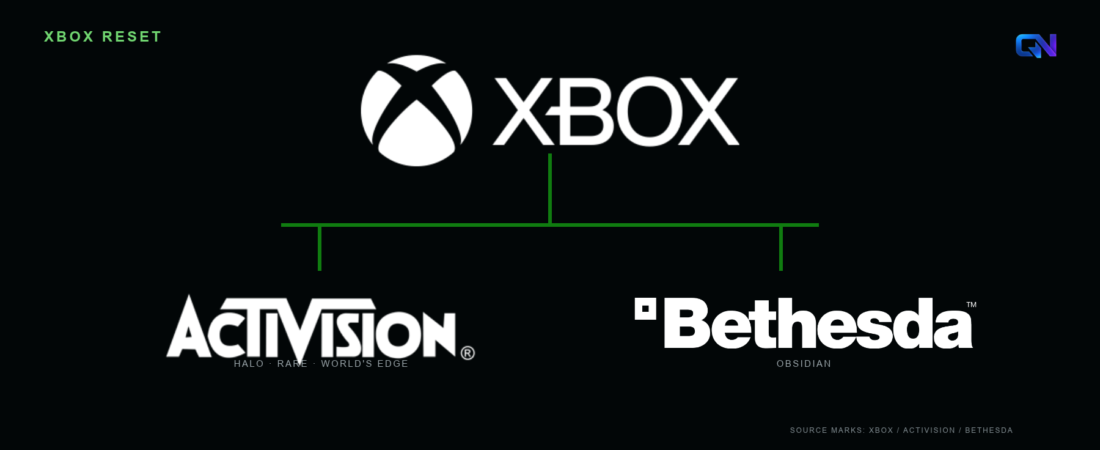
Halo, Rare and World’s Edge are moving under Activision, while Obsidian moves under Bethesda. Microsoft’s latest reset makes Xbox look less like one studio network and more like a portfolio run through specialist publishing groups.
Microsoft’s latest Xbox reset is easy to read as another layoffs story. The 268 additional role eliminations matter, especially for the people affected, but the more lasting change may be the new organisational map underneath them.
The next Halo title is moving to a purpose-built team under Activision. Rare and World’s Edge are joining Activision too. Obsidian is moving under Bethesda. King is taking Microsoft Casual Games. Playground Games and Turn 10 are being combined into one studio focused on Forza and Fable.
Microsoft still owns most of those businesses and franchises. What is changing is where they sit and who is expected to run them.
The result is an Xbox organisation that increasingly looks less like one large Xbox Game Studios network and more like a top-level gaming business with several powerful publishing groups underneath it.
September changes the shape of Xbox Game Studios
The September reset moves some of the names most closely associated with Xbox’s first-party identity away from the traditional Xbox Game Studios structure.
Activision gets the biggest expansion. Microsoft says it will take responsibility for Rare and World’s Edge, while also building the next Halo title through a new purpose-built team. A smaller Halo Studios group will remain focused on current Halo games and the existing community.
Bethesda’s remit expands to include Obsidian. Microsoft explicitly says Obsidian will continue its current projects, including Grounded and its new Fallout collaboration with Bethesda Game Studios. The move changes the reporting structure, not the existence of the studio or its announced work.
Playground Games and Turn 10 are becoming one studio focused on Forza and Fable. King, meanwhile, is taking Microsoft Casual Games.
Taken together, those moves redistribute important Xbox franchises into business units that Microsoft acquired over the past several years rather than keeping them all under one XGS umbrella.
Microsoft says the goal is to operate fewer business units, align teams that already work closely together and make better use of publishing expertise. That is the company’s rationale. The structural consequence is that Activision, Bethesda and King are becoming operating homes for more of Microsoft’s wider gaming portfolio.
XGS is becoming a smaller layer inside Xbox
Microsoft has not published a complete post-reset organisation chart, so there is still some ambiguity around the exact boundary of Xbox Game Studios after the September changes.
The September memo does not announce moves for The Coalition or inXile, and the merged Playground and Turn 10 team remains part of the wider Xbox first-party organisation. Current external reporting places those development groups, alongside Xbox Game Studios Publishing, at the centre of what remains under the XGS banner.
The exact number left under the XGS label depends on how Microsoft draws its internal boundaries. The direction is clearer: XGS is no longer the main umbrella for nearly every recognisable Microsoft-owned development studio.
Halo is the clearest example. The franchise remains owned by Microsoft and part of Xbox, but its next title will be built inside Activision rather than by the central Halo organisation that historically represented Xbox’s flagship series.
Rare and World’s Edge follow a similar pattern. Sea of Thieves and Age of Empires are not leaving Microsoft, yet the studios responsible for them will sit under Activision’s management structure.
Xbox can therefore become broader at the top while XGS becomes narrower underneath.
July already pointed in this direction
The September reset makes more sense when read as the next stage of Microsoft’s July changes rather than a standalone reorganisation.
In July, Xbox chief executive Asha Sharma announced a planned reduction of roughly 3,200 roles across the financial year, including about 1,600 immediate cuts. Microsoft also began moving studios out of Xbox ownership, simplifying management layers and trying to bring content, hardware, platform and services into one operating model.
Mojang and King were moved to report directly to Sharma. Helen Chiang was promoted to chief operating officer with end-to-end profit-and-loss responsibility across Xbox content, hardware, platform and services.
That July structure matters because it shifts the centre of gravity upward.
Instead of treating Xbox Game Studios as the place where Microsoft’s game-making identity has to live, Microsoft is building a broader Xbox business in which different publishing and franchise groups can sit beside one another under shared financial and strategic leadership.
The company’s broader Xbox hardware strategy is already moving in a similar direction. Project Helix has been presented less as one replacement console and more as a family-of-devices approach spanning Xbox and PC ambitions. The studio reset suggests the content organisation is also becoming less dependent on one traditional internal label.
Divestitures are part of the model too
Microsoft is not only moving studios between internal units. It is also deciding which teams should remain inside Xbox at all.
Compulsion Games and Double Fine became independent earlier in the reset. Undead Labs has now completed its separation and says it is operating as an independent, employee-owned studio.
State of Decay 3 remains in active development. Undead Labs says the game is in alpha, is still targeted for 2027 and is planned for Xbox, Game Pass, PC and PlayStation. Microsoft’s September memo also says the game will still launch into Game Pass through a new publisher.
Independence therefore does not automatically mean the franchise disappears from Xbox’s ecosystem.
Ninja Theory is in a more uncertain position. Microsoft says two divestiture agreements fell through and it has started employee consultation on a proposed closure while continuing to explore other options. Proposed is the important word. The studio has not been confirmed as closed.
Arkane also remains under consultation.
These cases show another part of the reset: Microsoft appears more willing to separate ownership, publishing relationships and platform distribution than the old first-party model implied.
What Xbox becomes is still unsettled
The September changes make Microsoft’s direction clearer without settling the final shape of Xbox.
The company is concentrating more operational responsibility inside Activision, Bethesda, King and other large business units. XGS is becoming a smaller part of that map. At the same time, Microsoft is keeping a top-level Xbox organisation that spans games, hardware, services, publishing and distribution.
What remains unclear is how much those internal labels will matter to players and developers over time.
Microsoft has not said Xbox Game Studios is being retired. It has not explained whether more studios will move under Activision or Bethesda. It has not shown how creative autonomy, budgets or release decisions will change inside the newly expanded groups. The future of Ninja Theory and Arkane is also unresolved.
For now, the safest conclusion is structural rather than cultural.
Xbox is not simply shrinking into Activision or Bethesda. Microsoft is using Activision, Bethesda, King and a reduced XGS layer as operating units inside a broader Xbox business.
The next question is whether that model produces clearer accountability and stronger games, or simply leaves the Xbox Game Studios identity less central than it has been for the past decade.