Blizzard is reviving StarCraft with a game that puts players inside the battlefield instead of above it. The move opens the franchise to a different kind of play without defining the future of StarCraft RTS.
StarCraft is finally getting a major new game, but Blizzard is not bringing it back in the form that defined the series.
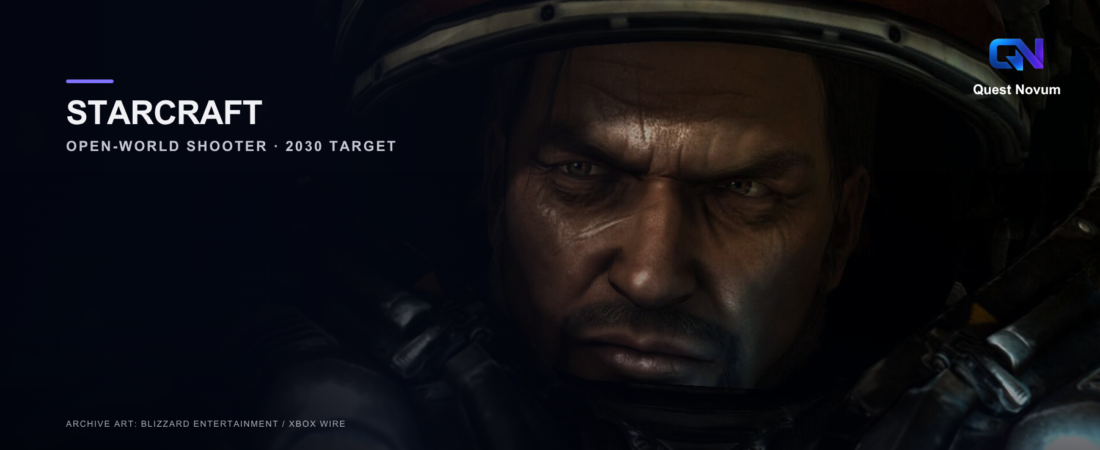
The new project, simply announced as StarCraft, is an open-world shooter targeting 2030. Blizzard revealed it during the BlizzCon 2026 Opening Ceremony, with Blizzard vice president Dan Hay presenting the project and a cinematic setting the tone.
The genre choice is the most revealing part of the announcement.
StarCraft became one of Blizzard’s defining franchises as a real-time strategy game. The original launched in 1998. StarCraft II: Wings of Liberty followed in 2010, and Blizzard spent the next several years expanding that RTS framework through Heart of the Swarm, Legacy of the Void and Nova Covert Ops.
Now, after years without a major new StarCraft game, the return starts somewhere else.
Instead of commanding the battlefield from above, players will experience StarCraft from ground level. Blizzard is building an open-world shooter inside the universe those armies fought over.
Blizzard has not explained why it chose a shooter. The reveal does show the version of StarCraft it wants to put in front of players first.
A shooter lets players enter StarCraft through its world
RTS games ask the player to think at the level of production, positioning, economy and battlefield control. StarCraft’s identity was built around that scale.
From ground level, familiar StarCraft pieces work differently.
Instead of selecting marines from above, the shooter format moves the player to the scale of an individual combatant. The same factions, weapons, creatures and locations can become spaces and encounters experienced at ground level.
At ground level, the fantasy changes.
The universe already has the material for it. Terran marines, Ghosts, Zerg swarms, Protoss warriors, dropships, siege tanks and hostile worlds were designed as units and environments inside an RTS, but they are also obvious action-game material.
The setting can work without making build orders, resource management or competitive RTS fundamentals the price of entry.
StarCraft is becoming easier to enter through its universe rather than through the control language of an RTS.
Blizzard has not said broader reach is the motive, but the format plainly changes who can approach the franchise and how.
It makes the setting, characters and combat fantasy more independent from the control scheme that historically defined the brand.
StarCraft has tried to leave the commander’s chair before
The idea is not completely new.
StarCraft: Ghost was announced in 2002 as a tactical action game built around Nova rather than an RTS commander. Development changed hands and the project was eventually cancelled after years in limbo.
Ghost matters here only as proof that Blizzard has long seen action-game potential in StarCraft.
The current project stands on its own terms.
The new StarCraft is arriving in a different market, under a different team and with a different structure. Ghost was a specific early-2000s console project. The 2030 title is being presented as an open-world shooter led by Dan Hay, whose previous work includes the Far Cry series.
The useful connection is narrower: StarCraft has always contained more action-game potential than its release history suggests. Blizzard is finally making that potential central to the franchise’s next major project.
The long gap makes the genre choice louder
The genre choice becomes more significant because Blizzard has waited so long to make another major StarCraft game.
StarCraft II launched in 2010. Legacy of the Void completed its trilogy in 2015, and Nova Covert Ops added a new RTS mission campaign in 2016. StarCraft: Remastered followed in 2017, modernising the original rather than creating a new direction for the series.
The franchise never disappeared. Blizzard kept StarCraft II running and continued issuing balance updates.
But a maintained RTS and a newly announced flagship project are different things.
When Blizzard finally used BlizzCon to say, in effect, “StarCraft is back”, it chose a shooter.
Calling this simply another new-game reveal misses the interesting choice.
The company could have returned with a new numbered strategy sequel and reinforced StarCraft’s existing identity. Instead, the first major new project shown to players is designed to expand what a StarCraft game can look like.
Even if Blizzard returns to RTS later, the comeback already broadens the franchise’s definition.
Calling it simply StarCraft raises the stakes
Blizzard has not announced this as StarCraft 3.
The project is simply being presented as StarCraft.
The name may change before 2030, and there is little value in building a theory around a title four years ahead of the target launch.
Blizzard is comfortable announcing far ahead of release. In comments to Bloomberg ahead of BlizzCon, Blizzard president Johanna Faries said unusually early announcements are meant to show confidence in the company’s biggest future bets and in its ability to deliver them.
For StarCraft, the 2030 target carries two messages. Players are being asked to wait roughly four years, and the date is still only a target. At the same time, Blizzard wants the early announcement to read as commitment rather than a distant possibility.
Still, the current presentation is notable. Blizzard is not framing the shooter publicly as a minor side experiment attached to a clearly separate mainline strategy series.
At reveal, this is StarCraft.
Using the bare StarCraft name gives the project more weight. Blizzard is asking players to accept that the franchise can describe something other than an RTS without needing an explanatory subtitle to do the work.
A broader StarCraft does not automatically mean the end of RTS
The open-world shooter reveal will inevitably raise the question of whether Blizzard is moving away from StarCraft’s RTS roots.
The announcement does not support that conclusion.
Blizzard has said nothing about whether another strategy game will follow or how this project fits alongside any future StarCraft games.
The clear shift is in how Blizzard is using the franchise.
For the comeback, Blizzard is treating StarCraft’s universe as something that can survive outside RTS.
If Blizzard pulls it off, StarCraft stops being a brand that only makes sense when the player is issuing commands from above. It becomes a setting the company can use across different kinds of games.
If StarCraft works across genres, Blizzard has more room to use the universe than it would with an RTS-only future.
The risk is losing the identity on the way. A shooter may be easier for new players to approach, but it still has to feel meaningfully like StarCraft rather than a familiar open-world action structure wearing Terran armour.
The cinematic cannot answer the identity question. No gameplay has been shown, and Blizzard has not confirmed final platforms, multiplayer or co-op structure, monetisation or a detailed release plan beyond the 2030 target.
The genre label tells us the direction. It does not tell us whether Blizzard can translate the franchise convincingly into it.
StarCraft is returning from a different point of view
StarCraft’s return is important because the franchise is active enough to get another major game after years of waiting.
The more interesting decision is that Blizzard is using that return to move the camera.
For decades, StarCraft asked players to command the war.
This time, the announced format puts them inside it.
RTS StarCraft may still have a future. What Blizzard has already shown is a willingness to let the franchise mean more than one genre when it finally brings it back.