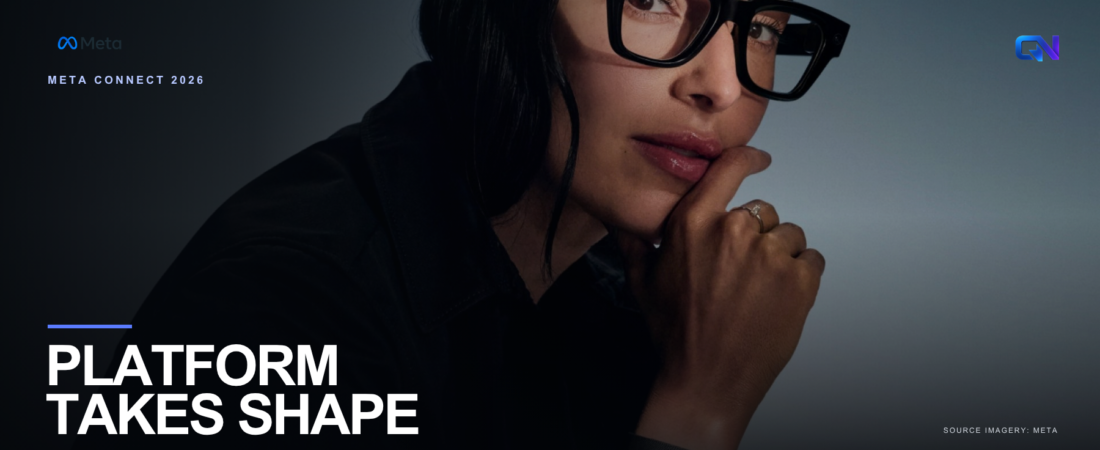
Meta Ray-Ban Display is now on sale in the UK, developers are getting stable AI-glasses tooling and new discovery surfaces, and the future Meta VR Glasses inherit Quest’s software stack. The pieces of a platform are appearing, but they do not yet form one unified ecosystem.
Smart glasses stop being interesting as a product category when every new pair has to justify itself as another isolated gadget.
Meta’s Connect announcements make a more ambitious case. Meta Ray-Ban Display is now on sale in the UK. Developers are getting a stable toolkit for extending mobile apps onto AI glasses, web apps can run directly on the Display model, and new discovery surfaces are being prepared on the glasses and inside the Meta AI app.
At the same time, Meta has introduced a separate pair of VR glasses for 2027 that inherit the operating system, Store, payment platform and SDK family already used by Quest.
Those moves give Meta something it has not previously had in glasses at this scale: hardware people can buy in more markets, multiple routes for developers to build, and distribution surfaces intended to help users find what developers make.
The catch is that Meta is building two glasses software stacks at once.
AI glasses are getting an app ecosystem
The most immediate platform shift is happening around Meta’s AI glasses, especially Meta Ray-Ban Display.
The glasses went on sale in the UK and Canada during Connect, alongside online ordering and wider European expansion. UK availability matters because platform ambitions need more than developer documentation. They need devices in users’ hands outside a limited launch market.
Meta is also moving its Wearables Device Access Toolkit out of developer preview. Version 1.0 begins rolling out on 30 September and is designed to let existing iOS and Android apps use capabilities on Meta’s glasses without rebuilding the whole product around a new operating system.
Meta says one integration can cover both display and displayless glasses, with access to capabilities including cameras, microphones, audio, motion and, where supported, the in-lens display.
For Ray-Ban Display, developers also have a second route: web apps built with standard HTML, CSS and JavaScript can run directly on the glasses. Meta is adding a browser-based simulator and a UI toolkit, while WebMCP in developer preview lets developers choose functions that Meta AI can call inside those web experiences.
A third route sits above the device itself. Meta AI Connectors let a service expose actions to Meta AI through an API or MCP server, with Meta saying the same connector can reach people through AI glasses, the Meta AI app and web.
This is closer to platform thinking than a catalogue of built-in features. It gives developers different entry points depending on whether they already have a mobile app, a web experience or an API-backed service.
Discovery is the missing piece Meta is now trying to add
Building software for a device is only half of a platform. Users also need a way to find it.
Meta says two discovery surfaces are coming for AI-glasses experiences. Ray-Ban Display will get an Explore app that can surface selected web apps directly on the glasses, while the Meta AI app will offer a catalogue of compatible experiences for connected glasses.
The company says developers can build and test now, and the Connect developer updates begin rolling out from 30 September. Submission and broader publishing details are still to come.
That distinction matters. Meta has announced the path towards distribution, but it has not yet demonstrated an open, mature glasses marketplace with a large third-party catalogue, meaningful developer revenue or sustained user demand for apps.
The platform ingredients are becoming visible. The ecosystem results are not.
Meta VR Glasses take a different route through Quest
Meta’s new VR Glasses make the broader strategy more interesting because they approach the same platform problem from the opposite direction.
The hardware is not due until spring 2027, but Meta has released version 207 SDKs so developers can start building and testing now. Meta says the glasses run the same operating system as Quest, use the same Store and payment platform, and work with the same SDK family.
For existing Quest developers, that removes one of the biggest risks attached to a new form factor. They are not being asked to abandon an established software and commerce stack simply because the hardware is moving from a headset towards lighter glasses.
The controller model changes. Meta VR Glasses are designed around eyes and hands by default, and some Quest software will need interaction or interface work. The underlying developer and distribution infrastructure, however, carries over.
This is a much more conventional platform advantage than the newer AI-glasses ecosystem. Quest already has a software catalogue, developer tools, payments and an audience. Meta VR Glasses can try to inherit those network effects rather than create them from zero.
One glasses strategy, two software architectures
It would be tempting to describe all of this as one Meta glasses platform. The current evidence is messier.
Meta VR Glasses inherit Quest’s operating system, Store, payments and SDKs. Meta’s AI glasses are built around mobile-app extensions, web apps, device-access tooling, Meta AI connectors and new curated discovery surfaces.
Those paths can reinforce each other at the company level. Meta can reuse identity, AI services, developer relationships, payment expertise and distribution across its wider ecosystem. Muse is also coming to AI glasses, giving Meta another service that can travel between devices and software surfaces.
Developers still face different technical models depending on which kind of glasses they are targeting.
Fragmentation is not automatically a problem. Phones, watches, TVs and consoles can sit inside one company’s ecosystem without sharing one operating system. The question is whether Meta can make the boundaries feel coherent enough that developers see a family of reachable users rather than several small device silos.
Privacy can decide whether the audience arrives
Developer tooling will matter only if people are comfortable wearing the hardware.
Camera-equipped AI glasses carry a different social burden from a phone or a VR headset. Reuters reported this week that smart glasses and other AI wearables are facing growing privacy concerns, including unease around covert recording and scrutiny of how captured data may be reviewed or processed.
Those concerns do not establish that the wider public will reject the category, but they do create an adoption problem that developer tooling alone cannot solve.
The platform question therefore has a social layer as well as a technical one. A brilliant SDK cannot create a large developer market if potential users reject the device category, regulators constrain it or social norms make routine use uncomfortable.
Meta has crossed an important line, but not the finish line
Connect 2026 gives Meta’s glasses strategy more substance than another hardware refresh.
Ray-Ban Display has expanded into the UK. AI-glasses developers have stable device tooling, web apps, connectors and upcoming discovery surfaces. Meta VR Glasses can inherit the Quest software and commerce stack rather than starting empty. Meta is also bringing Muse to its AI glasses, which could make AI a stronger shared layer within that part of the portfolio.
Those are credible platform building blocks.
They are not yet evidence of a successful platform.
Meta still has to show that developers publish useful experiences, users discover and keep using them, and the different glasses stacks reinforce each other rather than splitting attention. It also has to persuade people that camera-equipped, AI-connected wearables deserve a place in ordinary public life.
The difference after Connect is that those questions can now be asked about an emerging ecosystem, not just a collection of gadgets.