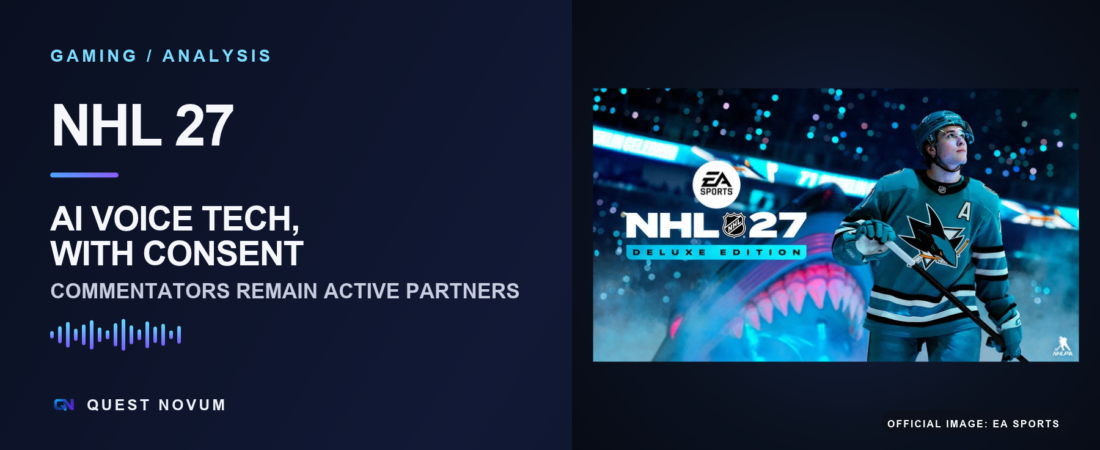
EA says John Buccigross and Darren Pang remain active partners, have completed more than 50 recording sessions and consented to AI voice technology expanding their commentary. That model is meaningfully different from replacement, but it does not answer every question about control, compensation or reuse.
The most interesting thing about NHL 27’s AI commentary is who is still in the booth.
EA says John Buccigross and Darren Pang remain the game’s commentary team and active partners in the production. According to the NHL 27 Update 1 blog, the pair have completed more than 50 recording sessions, while AI voice technology is being used with their “full consent and active collaboration” to expand that material.
That gives NHL 27 a much more specific AI story than the usual fear that a publisher will replace a performer with a generated voice.
EA’s model, at least as it describes it publicly, is augmentation. Human performers record the core material, help shape the broadcast and remain involved. Synthetic voice technology extends what can be built around those performances.
That distinction matters.
What the AI is supposed to solve
EA says the technology lets its NHL team add more variety, react faster to league changes and respond more quickly to player feedback.
Those are believable production problems for a sports game.
A commentary system has to cope with changing rosters, player and city names, new storylines and a large number of situational lines. Traditional recording can cover huge amounts of material, but every new session still needs scheduling, studio time, editing and implementation.
A synthetic version of a consenting performer’s voice could make some of those incremental updates easier to produce without changing the identity of the commentary team.
EA has not explained the technical workflow in enough detail to say exactly which lines are generated, how much of the final commentary is synthetic or when a recorded line is preferred over a generated one. The company’s wording is narrower: AI voice technology expands on more than 50 recording sessions.
That is the useful line to hold.
The original NHL 27 reveal already presented Buccigross and Pang as more than voices reading a script. EA said the two broadcasters brought their NHL experience into development, challenged the team on authenticity and helped shape the presentation.
The AI clarification does not replace that account. It adds another production layer to it.
Consent changes the problem
Using a recognisable performer’s synthetic voice without permission raises an obvious problem before you even get to quality.
NHL 27 at least answers that first question in public. EA says both commentators gave full consent and are actively collaborating with the use of the technology.
That is materially different from training a voice model on somebody who did not agree to it, or using a synthetic replica as a substitute after the performer has been pushed out of the production.
It also makes the simple question “is AI being used?” much less useful.
A better question is what the AI is allowed to do, under whose control and on what terms.
EA’s public blog does not disclose the commentators’ compensation for synthetic use, the precise scope of authorised generation, whether individual generated lines require approval, how long the permission lasts, what reuse is allowed outside NHL 27 or what contractual rights exist to limit future use.
None of those details is public, so consent tells us the performers agreed to this use, not the boundaries of the agreement.
A current games-industry labour agreement already treats those details as separate issues. SAG-AFTRA’s current Interactive Media Agreement, negotiated with an employer group that includes Electronic Arts Productions, requires clear consent and a reasonably specific description of intended use for covered digital replicas. It also requires usage reporting, while separate rules address matters such as additional uses and some forms of AI-generated dialogue.
There is no evidence that Buccigross and Pang are covered by those exact union terms, so they cannot simply be imported into NHL 27. The agreement is useful context because this formal industry agreement treats consent as part of a wider set of rules, not a single yes-or-no box.
Quality is a different test
There is another reason not to turn NHL 27 into a victory lap for synthetic voices.
EA’s own Update 1 notes fixes for player-name pronunciations and repetitive commentary lines, with more player and city-name coverage planned for future updates.
Quest Novum has not tested the implementation, so those patch notes are not evidence that AI caused the problems or that the commentary is good or bad.
They do underline a basic point. Permission and production efficiency do not guarantee quality.
A synthetic voice can be authorised by the performer and still produce awkward pronunciation, poor timing or repetitive delivery. A conventional recording can have quality problems too. The player ultimately hears the result, not the production method.
If AI is meant to make sports commentary more responsive and varied, the standard should be whether it actually improves that experience without making the performance feel less human.
NHL 27 is a more useful AI case than a replacement story
NHL 27 cannot settle the wider argument over synthetic performers in games, and it should not be asked to.
What it does show is a model that is easier to distinguish from straightforward replacement.
Buccigross and Pang recorded extensively. EA says they remain direct and ongoing partners. Their synthetic voices are being used with consent and active collaboration to extend the commentary rather than remove them from it.
Questions about pay, control, reuse and future boundaries are still open because EA’s public update does not describe the contract.
But it changes where the argument starts.
When the performer is still doing the job, helped shape the work and has agreed to the synthetic extension, AI becomes less about replacing a human voice and more about how far a digital version of that voice should be allowed to travel.
For NHL 27, that is the real test to watch as EA keeps expanding the commentary system.