Xbox Insider testing suggests a claimed digital licence can stay active without routine disc checks and can move when the same physical disc is claimed by somebody else. Microsoft’s own rules are broader, though, explicitly making access conditional on continued possession of the disc and reserving the right to revalidate or revoke the licence.
The most important thing Xbox’s new disc-to-digital system appears to preserve is not the convenience of digital libraries.
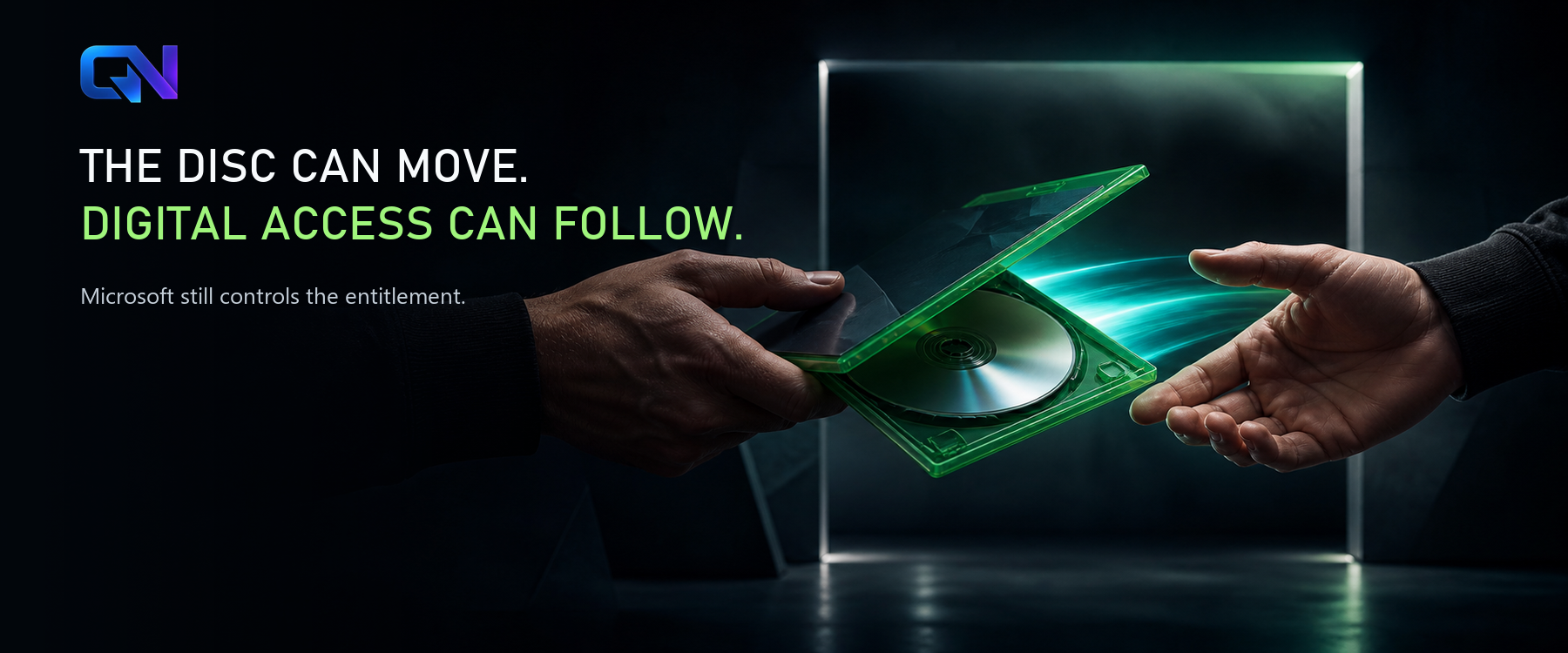
It is the ability to hand somebody the disc.
When we first covered Xbox’s disc-to-digital plan, the big unanswered question was what happened after a physical game created a digital entitlement. Could you sell the disc without leaving a permanent digital copy behind? Would Microsoft make you put the disc back into a console every few days? Could a delisted game still generate a licence?
The Insider rollout has now answered part of that.
Current behaviour looks surprisingly sensible for resale and lending. A supported disc can create a digital entitlement, the disc can come back out of the console, and Windows Central reports that the entitlement remains available without a routine timeout. If somebody else later inserts the same disc and claims it on another Microsoft account, the previous account loses the digital entitlement.
That makes the digital access behave less like a free permanent copy and more like a digital extension of the physical object.
But Microsoft’s own published rules leave itself more room than the current implementation appears to use.
That difference matters.
Current behaviour makes the disc the transferable key
Xbox announced the system as a way to give supported Xbox One and Xbox Series X discs the benefits of digital access, including Xbox Play Anywhere and Xbox Cloud Gaming where those features are available.
The launch pitch was broad. Microsoft said most Xbox One and Xbox Series X disc-based games support the feature, with thousands of titles available at the start and more to be added over time.
What the launch announcement did not explain in detail was how often the disc would need to prove ownership once a digital entitlement had been granted.
Windows Central has now tested the feature through the Xbox Insider programme. Its hands-on report says that once the digital entitlement is created, the disc can be removed and the game can still be installed and played from the digital library.
More importantly, the site says Microsoft sources confirmed there is no routine timeout requiring the disc to be reinserted simply to keep the digital licence active.
The transfer behaviour is equally important.
According to Windows Central, if the disc is sold or lent to another person and that user claims the entitlement on their own Microsoft account, the first account loses its digital rights until it gets the disc back or buys the game another way.
That is the behaviour a physical resale system needs if Microsoft wants the disc to remain meaningfully transferable.
One physical copy does not leave a trail of permanent digital copies behind it. The useful digital entitlement moves when the physical object moves.
Microsoft’s rules are deliberately broader
The current Insider behaviour is only one half of the ownership picture.
Microsoft has also updated its Usage Rules for Digital Goods with a specific section for “Disc to Digital Licensed Games”.
Those rules describe the entitlement as a “limited access digital license” granted when a supported Xbox One or Xbox Series X disc is inserted into a supported console and successfully claimed.
The important part is what comes next.
Microsoft says the digital licence remains conditioned on continued possession of the qualifying disc. It may require users to revalidate eligibility, and if a user no longer possesses the qualifying disc, access to the associated digital licence may be suspended or revoked.
The rules also say the digital licence cannot be transferred separately from the qualifying disc.
That is broadly consistent with the system behaving as an extension of the physical game.
It is not, however, the same as promising that the only possible way access can ever disappear is another person claiming the disc.
Windows Central’s Microsoft-source clarification describes how the current implementation works. Microsoft’s published rules define the rights Microsoft is reserving around that implementation.
Those two things are not necessarily contradictory.
A system can have no routine timeout today while its governing rules still allow Microsoft to require revalidation later, or to suspend or revoke a licence if the user no longer possesses the qualifying disc.
For players, that means the practical answer is more nuanced than “you never need the disc again”.
Right now, current Insider behaviour appears permissive. The legal and policy framework remains conditional.
That is still much better for resale than the obvious alternative
There was an easy way for Microsoft to make disc-to-digital much worse for physical ownership.
It could have treated the first claim as a one-way conversion: insert a disc once, bind a permanent licence to an account, and leave the physical copy economically awkward afterwards.
That is not what the current system appears to do.
Instead, the disc remains the thing that can change hands.
Sell it and the next owner can claim the useful digital access. Lend it and, based on current reported behaviour, the entitlement can move with the disc while the borrower has it.
The original physical game also continues to work as a physical game. Xbox’s launch material says the disc itself is not surrendered or disabled by claiming the digital entitlement.
That preserves the part of physical ownership people usually care about most: the copy can still be transferred.
The digital licence is an added service layer, not a replacement for the object.
It is a clever compromise. Microsoft gets to extend physical libraries onto devices that cannot read those discs, while the user does not have to give up resale or lending just to gain that convenience.
Delisted games make the preservation claim more interesting
The strongest new preservation evidence is not about current releases.
It is about games that are no longer being sold digitally.
VGC reports that Xbox Insiders have successfully generated new digital licences from physical copies of several delisted games, including Deadpool, F1 2021, Minecraft: Story Mode, Rock Band 4 and Titanfall.
That matters because a delisted store page no longer offers a normal route for a new customer to buy the digital licence.
If a legitimate physical copy can still create one, the disc is doing more than authenticating a game that is already easy to purchase online. It is reopening digital access to software whose normal digital sale has ended.
That is a real preservation benefit.
It is also important not to overstate it.
VGC’s examples show that some delisted titles work. They do not establish that every delisted game works, or that every publisher supports the programme in the same way.
Microsoft’s own rules explicitly say eligibility can vary for technical, licensing, publishing or other reasons. The company also reserves the ability to add or remove eligibility for specific discs over time.
So the preservation value is genuine, but it is not unconditional.
A disc being physically intact does not guarantee that Microsoft will always be able or willing to generate the additional digital entitlement for it.
The model is physical ownership with a conditional digital layer
The distinction is becoming clearer now.
The physical disc is the transferable object. You can possess it, sell it, lend it and, where the hardware still supports it, use it as a physical game.
The new digital entitlement sits on top of that.
It can make a supported physical library useful on Xbox Series S, Windows devices through Xbox Play Anywhere, handhelds and Xbox Cloud Gaming where the title supports those routes.
That is valuable, especially as Xbox hardware becomes less tied to one console shape.
But the entitlement is still a licence managed through Microsoft’s account and service infrastructure.
Microsoft’s rules say all digital goods are licensed rather than sold, and the new disc-specific section is explicit that this particular licence remains conditional on the qualifying physical disc.
The best way to think about the feature is therefore not “my disc became a permanent digital copy”.
It is “my disc can now unlock digital access while Microsoft continues to recognise my entitlement to that access”.
That sounds like a small wording difference.
For long-term ownership, it is the whole story.
The Quest Novum take
Xbox appears to have solved the most obvious resale problem with disc-to-digital in a genuinely consumer-friendly way.
The digital entitlement currently follows the physical object instead of destroying the reason to own the physical object in the first place.
That is better than locking a free digital copy permanently to the first account that inserts a disc, and it gives old physical libraries new value on hardware that cannot read them directly.
The early delisted-game results make the preservation case stronger too. A physical copy creating a new digital licence after ordinary digital sales have ended is exactly the kind of bridge that can keep older libraries useful.
The caveat is that the bridge still belongs to Microsoft.
Current Insider behaviour says there is no routine timeout. Microsoft’s own rules still reserve broader powers to revalidate eligibility, suspend or revoke access, and change which discs qualify.
Both facts matter.
The interesting achievement here is not that Xbox has turned physical games into permanent digital games.
It is that Xbox may have found a way to make digital convenience follow the disc without stripping the disc of its practical resale and lending value.
That is a much more useful ownership model than the announcement first made clear.