Xbox’s new disc-to-digital system can give supported physical games digital access across more of its ecosystem. The disc still works and current reporting suggests the entitlement can move with it, but Microsoft has not yet explained several important ownership and validation rules.
Physical games have one advantage digital libraries have never quite replicated.
You can hand somebody the copy.
Sell it. Lend it. Leave it on a shelf for years. With a conventional physical game, the disc remains the transferable object that gives you access to the copy.
Xbox is now trying to make that physical object do something much more digital.
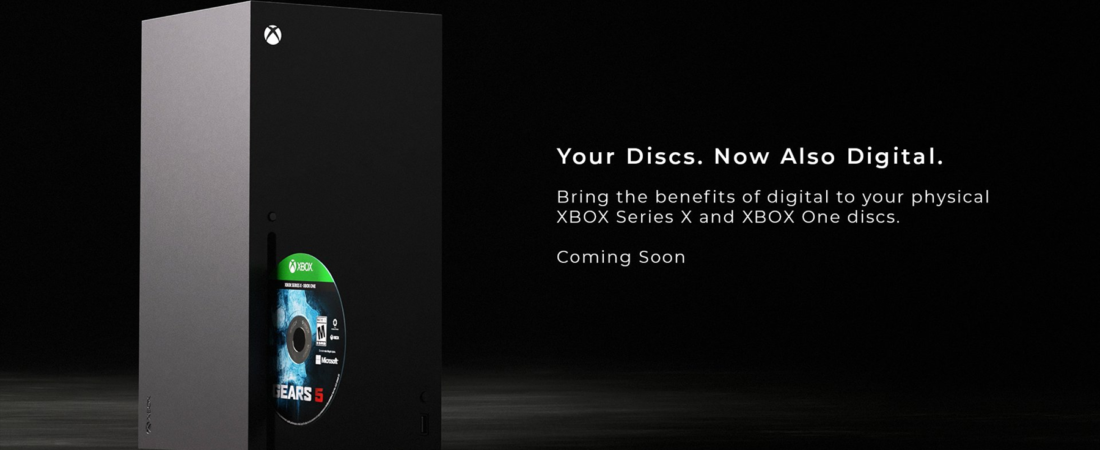
Microsoft has announced Your Discs. Now Also Digital, a new system that lets supported Xbox One and Xbox Series X discs grant a digital entitlement when inserted into a console and launched.
Xbox Insiders start testing it on 31 August.
Microsoft says most Xbox One and Xbox Series X disc games support the feature, with thousands included initially and more coming later.
Once the entitlement is claimed, compatible games can gain digital benefits including Xbox Play Anywhere and Xbox Cloud Gaming.
The physical disc does not get surrendered or disabled.
Xbox says it continues working exactly as it did before. Xbox Wire
That sounds like a straightforward convenience feature.
The ownership mechanics underneath it are considerably more interesting.
The disc can now unlock something it could not before
Until now, the distinction around Xbox Play Anywhere has been fairly clear.
Microsoft’s own FAQ says Play Anywhere applies to qualifying digital games. Own one and you can play across Xbox consoles, Windows PCs and supported Windows handhelds without buying the game again. Xbox Play Anywhere
A physical disc does not fit neatly into that system.
Your PC handheld does not have an Xbox disc drive. Neither does a browser streaming a game from the cloud.
Your Discs. Now Also Digital creates the missing bridge.
The physical game establishes a digital entitlement, and that entitlement can potentially unlock the same cross-device benefits if the title supports them.
That means an Xbox disc can become useful on hardware the disc itself could never physically enter.
For anybody sitting on a large physical library, that is a substantial change.
But this is not simply a free permanent digital copy
The word entitlement matters.
Microsoft is not saying that inserting a £20 second-hand disc permanently creates another independent digital game that remains yours after the disc disappears.
The Verge reports that the entitlement is tied to the specific disc and can move between accounts when that disc changes hands or is used under another Xbox profile. The Verge
The fine print on Microsoft’s announcement artwork has also been reported as specifying one revocable digital licence per game disc. VICE
Taken together, that points towards a much more sensible ownership model.
The physical disc remains the transferable object. According to current reporting, the digital entitlement follows it.
Sell the disc and, according to current reporting, the next owner can claim the entitlement while the previous owner loses it. The Verge
That matters because otherwise the system would immediately undermine the basic economics of physical games. One disc could simply travel between accounts leaving permanent digital copies behind.
The reported system avoids that.
What Xbox has not yet given consumers is a proper FAQ explaining exactly how the transfer works.
So how does Xbox know you still own it?
This is where the preservation question becomes interesting.
Imagine claiming a disc entitlement, putting the physical copy back on your shelf and then playing digitally on another device.
Microsoft now needs some way of deciding when you stop controlling that disc.
Current reporting gives us part of the answer: if the specific disc is used by another account, its entitlement can move. The Verge
The rest is still unclear.
Does Microsoft periodically validate the entitlement?
Can you play indefinitely without inserting the disc again as long as nobody else claims it?
What happens when the console is offline?
How quickly does an entitlement disappear after the disc is sold?
What happens if you lend the game to somebody for a weekend?
Can the entitlement move backwards and forwards cleanly as the disc changes hands?
Microsoft has not publicly answered those questions.
That is not evidence that something sinister happens behind the scenes.
It simply means the most important ownership mechanics are still missing from the announcement.
Insider testing beginning on 31 August should finally give players a chance to see some of those edge cases for themselves.
This might actually preserve one of physical gaming’s best features
Digital ownership is convenient.
Physical ownership is transferable.
Those two things have traditionally been difficult to combine.
Microsoft may have found a fairly elegant compromise.
If the system behaves as currently reported, you can still sell or lend the disc because the useful digital entitlement follows the physical object instead of remaining permanently attached to its first owner. The Verge
At the same time, while you possess it, that disc can potentially unlock play on PCs, supported handhelds and cloud devices that have nowhere to put it.
That is a broader preservation proposition than backwards compatibility alone, because it could make an existing physical library useful on devices that cannot read those discs directly.
It lets the existing object remain useful as Xbox hardware changes around it.
Microsoft explicitly describes the system in those terms, saying it wants players’ libraries to move forward as technology, devices and distribution evolve. Xbox Wire
There is still a catch.
The new convenience is digital.
Preservation through Microsoft’s servers is still preservation with conditions
The physical disc continues to exist.
That part has not changed.
If your current Xbox can read and play it normally, Microsoft’s announcement says it keeps doing so. Xbox Wire
But the additional entitlement is something different.
Microsoft’s general rules describe digital goods as licensed rather than sold and allow technical systems to verify licence compliance. Xbox digital games also use account and device licences to determine where they can be played. Microsoft Support
Those are Microsoft’s existing general digital rules, not a specific explanation of Your Discs. Now Also Digital.
We should not assume every rule applies to a disc-derived entitlement in exactly the same way.
But the wider point remains.
The moment a physical game starts providing digital access across PCs, handhelds and cloud services, part of that access depends on Microsoft’s infrastructure continuing to recognise the entitlement.
That does not make the physical game less physical.
It does mean the preservation claim has two different layers.
The disc preserves the copy you physically possess.
Microsoft’s entitlement system preserves the extra ways you can access it.
Not every Xbox disc is covered
There are limits from day one.
Microsoft says most Xbox One and Xbox Series X discs are supported.
Not all of them.
The company is starting with thousands of titles and says it will continue adding more, but it has not yet published a complete initial compatibility list. Xbox Wire
The announcement also does not extend the feature to original Xbox or Xbox 360 discs.
The Verge reports that publisher participation affects whether titles are included. That participation rule has not yet been explained in Xbox’s public announcement. The Verge
That makes the preservation claim dependent on more than the physical media itself.
A disc being on your shelf does not automatically mean Microsoft can grant it every digital benefit.
Rights, platform support and publisher participation can still matter.
The Quest Novum take
There is a genuinely good idea here.
Xbox is trying to let a physical game keep the thing digital ownership usually loses, the ability to sell or lend it, while gaining much of the convenience digital ownership provides.
If the reported entitlement-transfer behaviour works cleanly, that is far more consumer-friendly than permanently converting a physical copy into a non-transferable account licence.
It could make physical Xbox collections considerably more useful as the platform moves across consoles, PCs, handhelds and cloud gaming.
But calling that preservation does not end the conversation.
It starts another one.
Microsoft still needs to explain exactly how revocation, validation, resale, lending, offline use and long-term eligibility work.
The physical disc is not disappearing.
What is changing is what Xbox can build on top of it.
Starting on 31 August, Insiders should finally be able to show us where the physical game ends and the digital entitlement begins.