NVIDIA says Hugging Face will remain open across rival models, clouds, inference providers and computing platforms, with no requirement to use NVIDIA hardware. That promise matters because Hugging Face increasingly sits between developers and the competing AI services they use to discover, test and deploy models.
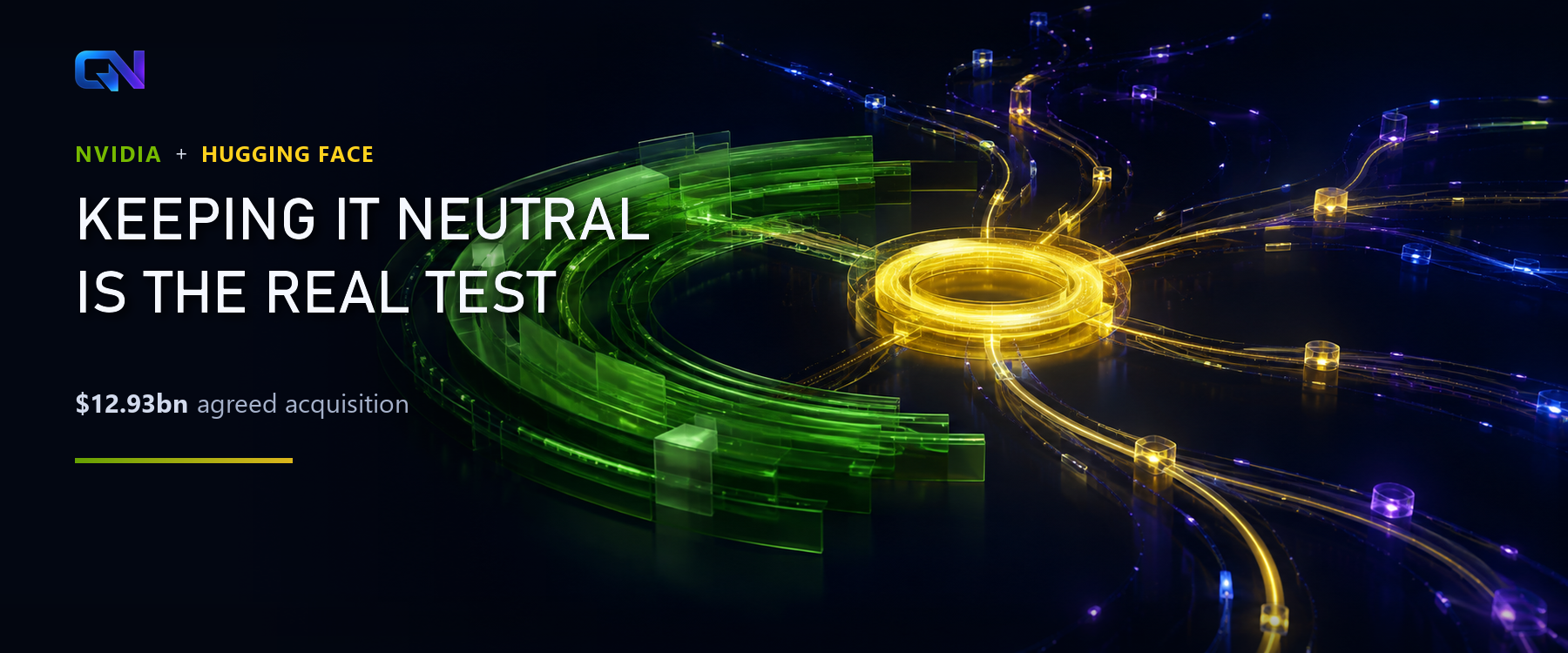
NVIDIA says it has agreed to acquire Hugging Face in a transaction it values at exactly $12,930,300,000.
Even by the standards of the AI boom, that is a startling number. But the most consequential part of the announcement may be a promise that costs nothing to write down and could become much harder to prove once the companies sit under one owner.
NVIDIA says Hugging Face will remain an open platform for the entire AI ecosystem. Developers will still be able to choose their models, frameworks, clouds, inference-service providers and computing platforms. NVIDIA compute, the company says, will not be required to build on or deploy through Hugging Face.
That commitment matters because Hugging Face is not simply another AI company sitting beside NVIDIA’s chip business. It has become one of the places where competing parts of the AI industry meet.
An NVIDIA filing with the US Securities and Exchange Commission adds important detail to the headline price. It describes approximately $11.9bn payable to Hugging Face stockholders, subject to adjustments, plus an equity-based retention programme of up to approximately $1bn for Hugging Face employees who join NVIDIA.
The filing says the transaction is expected to close in the first half of 2027, subject to customary closing conditions including required regulatory approvals. For now, this is an agreed acquisition, not a completed one.
Hugging Face is an AI crossroads, not just a model library
According to NVIDIA, more than 18 million developers, researchers and creators use Hugging Face to share more than 3 million models, 500,000 datasets and 1 million applications. More than 200,000 companies use the platform to discover, evaluate, customise and deploy AI.
Those numbers help explain the size of the deal. The way Hugging Face sits inside the development process explains why its ownership matters.
A developer can arrive at the Hub to find a model, inspect its documentation, compare options and then move towards running or deploying it. Hugging Face has also pushed inference-provider choice directly into that experience. Its model pages can expose hosted inference, its search can filter models by provider, and its Inference Providers service gives developers one interface across a long list of competing inference companies.
Current Hugging Face documentation lists providers including Cerebras, Cohere, Groq, Replicate, Together, OVHcloud, Nscale and others alongside Hugging Face’s own inference service. Developers can select a provider themselves or use automatic routing based on their provider preference order and availability.
Hugging Face’s dedicated Inference Endpoints also let customers choose between AWS, Microsoft Azure and Google Cloud Platform. Its current configuration options include CPU, GPU and AWS Inferentia accelerator types.
That makes Hugging Face more than a place where AI files are stored. It is increasingly a decision surface between models, infrastructure providers and deployment paths.
It is also worth being precise about the word open. Hugging Face is closely associated with the open-model community, but not every model hosted on the Hub should be described as open source. Hugging Face’s own repository documentation supports a wide range of licences, including research, community and custom terms. The strategic importance here comes from the breadth of the platform, not from pretending every asset on it has the same licensing status.
Neutrality is already part of how the platform works
Hugging Face has described independence across competing ecosystems as part of its identity before.
In January 2024, co-founder and CEO Clément Delangue pointed to commercial collaborations with AWS, Google Cloud and Azure as well as NVIDIA, AMD, Intel and Qualcomm when describing Hugging Face’s ambition to be an independent and agnostic platform for AI builders.
That idea is now visible in ordinary product decisions.
Provider selection is one example. When a developer uses Hugging Face’s automatic inference routing, the service selects the first available provider for that model based on the user’s preference order. A developer can also explicitly choose a provider instead.
Cloud deployment is another. Hugging Face’s managed Inference Endpoints currently span the three major cloud platforms rather than locking the user to one provider.
None of this means every option is identical, equally available or equally useful. It does mean that choice between competing ecosystems is already built into parts of the product.
Once NVIDIA owns Hugging Face, those choices acquire a new significance. NVIDIA has a direct commercial interest in its own compute platform, software stack, models and services. Hugging Face’s value to developers, meanwhile, partly comes from being useful even when they choose something else.
That does not mean NVIDIA will compromise the platform’s neutrality. It means neutrality will become something users can judge through product behaviour rather than corporate structure.
Reuters reported that some analysts and developers are already asking whether NVIDIA could gradually make rival hardware less attractive on Hugging Face without formally blocking it. The same report notes that major NVIDIA customers including Meta, OpenAI and Microsoft are developing their own AI chips, giving NVIDIA another reason to stay close to the developer layer as competition broadens.
That is independent context, not evidence of preferential treatment. It does, however, explain why NVIDIA’s neutrality promise will be scrutinised through ordinary product behaviour rather than taken on trust.
NVIDIA’s promise is unusually explicit
The strongest reason not to assume the worst is that NVIDIA has made a very clear commitment in public.
Its announcement says developers will continue to choose the models, frameworks, clouds, inference providers and computing platforms they want, and explicitly says NVIDIA compute will not be required.
The SEC filing goes further in one important respect. NVIDIA says it has committed to keeping Hugging Face open in a way consistent with existing practices, including continuing to let users upload and download the models and datasets they choose and supporting other silicon vendors.
That is much more meaningful than a vague promise to preserve the brand or keep operating as usual.
What the announcement and filing do not explain is how that neutrality will be protected in day-to-day product decisions after ownership changes.
Quest Novum has asked NVIDIA how Hugging Face’s hardware and cloud neutrality will be protected in practice across model discovery, hosted inference and future integrations. We will update this article if NVIDIA provides further on-record detail.
Watch the defaults, not just the compatibility list
The most useful tests of neutrality may be mundane.
Does model discovery continue to give competing ecosystems credible visibility? Do inference-provider integrations remain open to rivals on comparable terms? Does automatic routing remain transparent and controlled by user preferences? Do competing clouds and silicon platforms continue to receive timely, first-class support as Hugging Face adds new deployment features?
Those are not allegations about what NVIDIA plans to do. They are the places where ownership incentives could become visible if the platform’s behaviour changes.
There is also no contradiction in NVIDIA integrating its own technology deeply into Hugging Face while keeping the platform neutral. A neutral platform does not have to pretend its owner does not exist.
The real test is whether NVIDIA’s integrations become additions to genuine choice or gradually become the path of least resistance at the expense of competing options.
That distinction matters because defaults are powerful. Hugging Face already sits close to the moment when a developer moves from finding a model to deciding how to run it. Small differences in search prominence, provider availability, routing, documentation quality or integration effort can influence that decision without any rival being formally blocked.
The acquisition is not done yet
The timetable leaves room for scrutiny before any of this becomes an ownership reality.
NVIDIA’s SEC filing says the deal is expected to close in the first half of 2027 and remains subject to customary closing conditions, including required regulatory approvals. The filing does not announce bespoke regulatory remedies or conditions at this stage.
Until closing, the important facts are relatively simple. NVIDIA has agreed to buy Hugging Face. It has made an unusually specific commitment to keep the platform open across models, clouds, providers and computing platforms. Hugging Face already has product surfaces where that neutrality can be observed.
The $12.93bn headline makes the acquisition spectacular. The neutrality promise is what makes it consequential.
If Hugging Face remains a place where developers can choose competing models, infrastructure and deployment routes without being pushed towards NVIDIA hardware, NVIDIA will own a platform whose value partly depends on not behaving like a captive NVIDIA storefront.
NVIDIA has stated that intended outcome clearly. What developers should watch now is whether the promise remains visible in the ordinary defaults, integrations and choices that make Hugging Face useful after the ownership changes.