Nintendo waited 19 years between brand-new 2D Metroid stories before Dread. Ravenous is due just over five years later, after Samus Returns had already revived the format in 2017. That is a very different pattern, even if it is too early to call 2D Metroid a regular Nintendo pillar.
For most of modern Nintendo history, asking when the next 2D Metroid would arrive meant accepting that the answer might be: not for a very long time.
Metroid Ravenous changes that assumption.
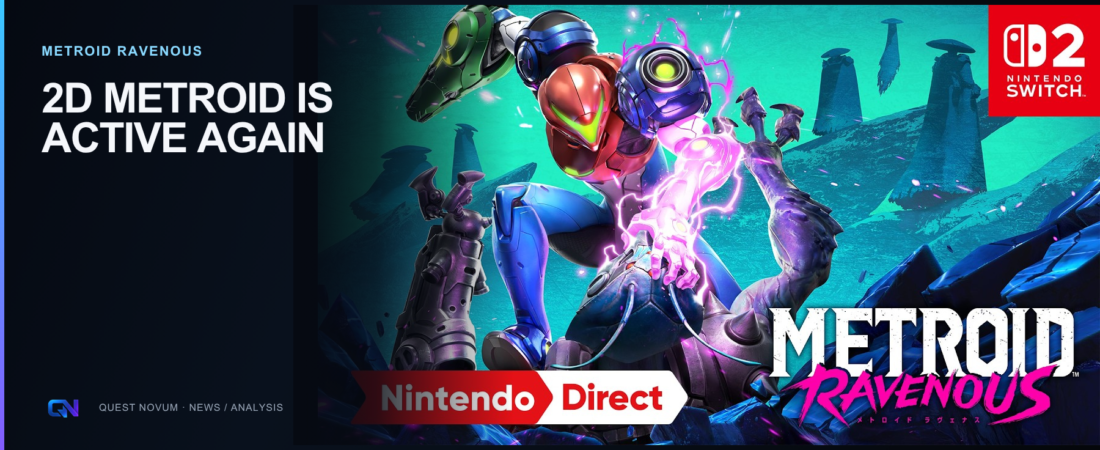
Nintendo revealed Ravenous during its 9 September Direct as the latest game in the 2D Metroid series, coming to Nintendo Switch 2 on 28 January 2027. The presentation showed a mysterious group attacking Samus Aran and described what it called “an ability that appears to drain energy”, before landing on the line “It’s eat or be eaten.” Nintendo has not yet explained that mechanic in enough detail to say exactly how it works, and the announcement material checked by Quest Novum does not identify the developer.
The more revealing detail is the date.
The gaps have collapsed
Metroid: Samus Returns launched on Nintendo 3DS on 15 September 2017. Metroid Dread followed on Nintendo Switch on 8 October 2021. Ravenous is scheduled for 28 January 2027.
That gives Nintendo three major 2D Metroid releases across a little under ten years, with gaps of roughly four years and then a little over five.
The previous pattern looked nothing like that.
Metroid: Zero Mission, a remake of the original Metroid, arrived in 2004. Nintendo then went 13 years without another 2D Metroid release before Samus Returns. The gap between genuinely new stories was even longer: Metroid Fusion arrived in 2002, and Nintendo itself marketed Dread as the first new 2D Metroid story in 19 years.
Ravenous therefore matters before launch. Nintendo is no longer asking the side-scrolling branch of Metroid to reappear after a decade-plus absence.
Samus Returns and Dread were different kinds of comeback
There is an important distinction inside that recent run.
Samus Returns was not a new chapter in the saga. Nintendo describes it as a complete reimagining of 1992’s Metroid II: Return of Samus. Its significance was that Nintendo was making a substantial 2D Metroid again after the long post-Zero Mission gap.
Dread went further. Nintendo described it as the first brand-new title in the 2D saga for 19 years, following Metroid Fusion. It was not simply another remake testing whether the old format still had an audience.
Ravenous now makes the sequence harder to dismiss as a one-off revival. Nintendo is following Dread with another all-new 2D adventure on its next hardware generation, and it already has a firm release date little more than five years after Dread.
That is the strongest evidence for the cadence argument. The format has moved from remake-led reactivation to consecutive new 2D releases.
Dread also supplied clear evidence of demand. Nintendo reported 2.90 million units sold by the end of March 2022, giving the previous new 2D entry a sizeable documented audience soon after launch. Nintendo has not said that performance caused Ravenous to be greenlit.
Dread was a finale, Ravenous keeps the format moving
Dread was also unusual because Nintendo presented it as the conclusion to the five-part saga linking Samus and the Metroids that began with the original game.
That could have provided a natural stopping point for the traditional 2D series. Instead, Nintendo has announced another new side-scrolling entry for Switch 2.
That makes Ravenous more significant than a routine new-game reveal. Nintendo is continuing to invest in 2D Metroid after finishing the story arc it had spent decades trying to complete.
The reveal suggests the next game is not being treated like a museum piece either. Nintendo’s energy-draining tease and “eat or be eaten” framing point towards a new central idea rather than a simple recreation of older mechanics. Until Nintendo explains the system properly, that is as far as the evidence should go.
Active series is a safer claim than regular pillar
The temptation now is to declare that 2D Metroid has become one of Nintendo’s regular pillars. The release history does not quite justify that yet.
Three 2D releases since 2017 is a clear change from the previous droughts, but only two of them are brand-new entries. There is no announced schedule beyond Ravenous, no confirmed developer continuity in the current Nintendo material, and no evidence that Nintendo has committed to a fixed four-, five- or six-year production cycle.
A cadence can emerge without becoming a clock.
What Ravenous supports is the narrower claim that 2D Metroid has returned to active development as a recurring part of Nintendo’s software slate. Samus Returns restarted production in the format. Dread delivered a genuinely new entry four years later. Ravenous is due a little over five years after that, on a new console generation.
That is enough to retire the old assumption that every new 2D Metroid is an improbable resurrection.
For years, the question was whether Nintendo would make another new 2D Metroid at all. Ravenous moves the uncertainty forward. The next test is whether Nintendo keeps the line moving after this one.