
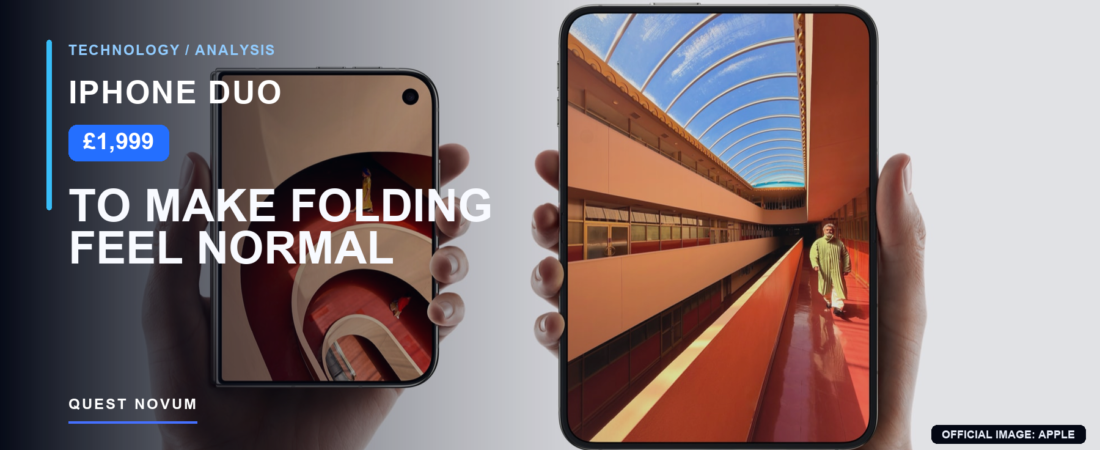
Apple’s first foldable remains an ultra-premium £1,999 purchase. Its bigger bet is familiarity: a conventional outer iPhone experience, a larger inner canvas and iOS 27 designed around the hinge.
Apple has finally made a foldable iPhone, and it starts at £1,999 in the UK.
That price keeps iPhone Duo firmly in ultra-premium territory. Apple is starting at the luxury end of the category. The more interesting move is to make folding feel like a normal part of using an iPhone.
Duo has a 5.4-inch outer display for ordinary phone use and a 7.6-inch inner display when opened. It runs the same A20 Pro chip as Apple’s iPhone 18 Pro models, and Apple is launching it across more than 70 countries and regions in the first wave, including the UK. Pre-orders open on 16 October before availability on 23 October.
The hardware matters, but Apple’s pitch is built around what happens between the two screens.
The pitch is familiarity
Apple says the outer display gives more than 90 percent of the screen area of iPhone 18 Pro. The inner and outer displays use the same aspect ratio, so content can scale proportionally as the device opens and closes.
That sounds like a small design decision. It gets to the centre of what Apple is trying to do.
A foldable can easily feel like two products awkwardly joined together: a narrow phone when closed and a small tablet when open. Duo is being presented as one iPhone that changes size.
iOS 27 carries a lot of that work. Split View lets two apps run side by side on an iPhone for the first time. Users can save app pairs, open two windows of the same app and move between the outer and inner displays. Apple has also adapted StandBy, FaceTime and camera features around the different positions the hinge can hold.
Those features make the fold itself useful rather than decorative. Duo Preview can show the person being photographed a live view on the outer screen. The phone can stand by itself for video calls or media. Open it fully and the larger display becomes a multitasking surface.
This is where Apple has the strongest case that Duo changes something for its own customers. The form factor is being integrated into iOS rather than added as a large screen with a hinge and left for apps to figure out.
Samsung has already proved the basic foldable playbook
None of those ideas starts with Apple.
The foldable-phone category is already in its eighth generation. The current Galaxy Z Fold8 also uses a 7.6-inch inner display and a smaller outer display, while One UI supports side-by-side apps, split views and software designed to move between the cover and main screens. Samsung’s Flex Mode has also used partially folded positions for hands-free viewing and app controls for years.
That context matters because the foldable-phone concept and its basic behaviours are already established. Apple is entering after years of public iteration by Samsung, Huawei, Motorola and others.
Its opportunity is to bring those behaviours into the Apple ecosystem.
Until Duo, an iPhone user who wanted a book-style foldable had to move to another mobile platform. From 23 October, that trade-off disappears for buyers willing to pay the price. iMessage, FaceTime, iCloud, Apple Watch integration and the rest of the iPhone experience can now sit inside the form factor competitors spent years refining.
That is a meaningful category change even if the underlying foldable ideas are familiar.
£1,999 keeps the mass market out of reach
Foldables are still a niche in unit terms. Counterpoint Research said they accounted for 1.6 percent of global smartphone shipments in 2025, despite several years of product development and wider consumer awareness.
Apple is using ecosystem familiarity rather than price as its lever.
At £1,999, Apple’s starting price is higher than Samsung’s current UK recommended price of £1,699 for Galaxy Z Fold8 and £1,899 for Galaxy Z Fold8 Ultra. The first foldable iPhone is being sold above established premium foldables rather than undercutting them.
That makes Apple’s launch strategy easier to read. Apple is aiming first at the status of the foldable inside the flagship tier.
Apple’s own product material groups iPhone Duo with iPhone 18 Pro and iPhone 18 Pro Max as flagship smartphones sharing A20 Pro. The company is treating the foldable as another top-end iPhone choice, even though its price sits well beyond the ordinary flagship tier.
The broad launch footprint reinforces that positioning. Apple is putting Duo straight into its normal retail machine across major regions from the first wave.
That scale of distribution can make the category far more visible. Mainstream adoption still has to be earned.
The category shift starts with choice
The most immediate change is simple: folding is now an option inside the iPhone family.
That matters because mainstream categories are often built before they become mass-market products. Expensive features arrive at the top, software ecosystems adapt around them, developers learn what people actually use, and the market decides whether the idea deserves to spread.
Duo gives Apple a chance to run that process with the foldable form factor for the first time.
The familiar hardware concept is almost beside the point. Apple’s advantage is the size of the installed iPhone ecosystem and its ability to make a new interaction model feel native across hardware, software, services and retail.
The hard part comes after launch. Apple still has to show that iPhone users want the extra screen enough to live with a £1,999 starting price and the practical compromises of a folding device. The announcement provides no evidence yet about long-term demand, durability in ordinary ownership or whether buyers will use the software features often enough to justify the form factor.
Foldables remain niche. They represented a small fraction of smartphone shipments before Apple arrived, and Duo is priced as one of the most expensive phones in the category.
What has changed is where the foldable sits in the market. It is no longer something iPhone users have to leave iOS to buy.
Apple is arriving after years of foldable development. With iPhone Duo, it is trying to make folding a normal question at the top of the smartphone market: do you want your next flagship iPhone to open up into something bigger?