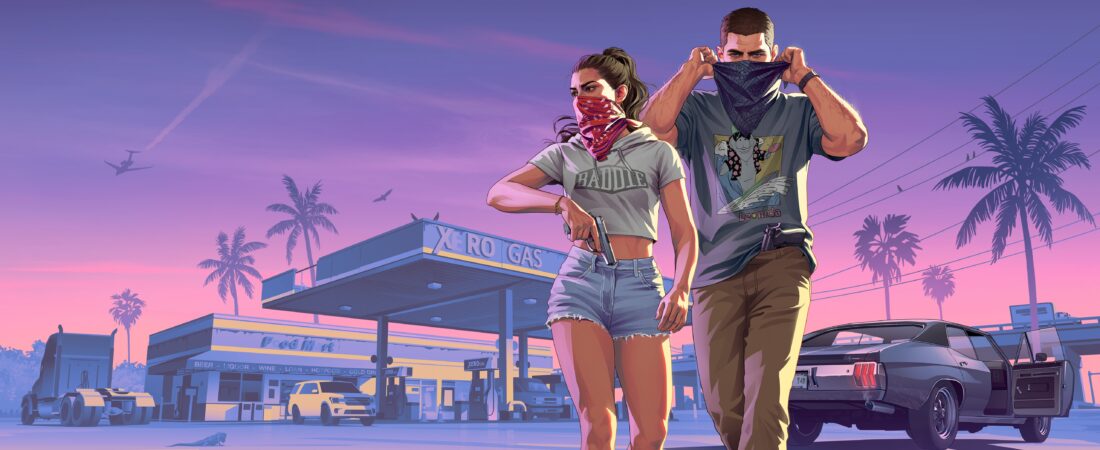
Rockstar’s Extended Look showed more than a spectacular version of Vice City. Vehicle theft, disguises, police recognition and reactive civilians point towards a criminal sandbox built from connected choices.
GTA VI looks astonishing. That was never the difficult part to predict.
Rockstar’s Extended Look is almost 27 minutes of dense streets, elaborate interiors, crowded clubs, swamp water and obscenely detailed cars. Netflix describes it as captured entirely from in-game footage on PlayStation 5. GTA VI is due to launch for PS5 and Xbox Series X|S on 19 November 2026, according to Rockstar’s official game page.
Look past the production values, though, and the more interesting reveal is how many everyday criminal actions now have systems behind them.
Stealing a parked car is no longer presented as one automatic animation. Robberies involve masks, clothing choices, frightened witnesses and shopkeepers who may fight back. Police appear to remember more than a wanted level. Even bystanders and social-media users can become active parts of the chaos.
The details shown in the presentation, combined with Rockstar’s post-show interviews, point towards a game built around connected criminal decisions: preparation, approach, witnesses, identification and escape.
Stealing a car is now a decision
One of the clearest examples arrives when Jason approaches a parked car.
Two prompts appear: Slim Jim or Smash Window.
Choosing the Slim Jim starts a short right-stick interaction. Smashing the window offers the more direct alternative. In a few seconds, Rockstar turns one of Grand Theft Auto’s most familiar actions into a choice between force and preparation.
That is what the official footage visibly establishes.
Rockstar has separately confirmed that the wider system goes much further.
Rockstar North co-studio head Rob Nelson told IGN that parked vehicles have different security requirements, while progression unlocks tools including slim jims and key cloners. An in-game app can identify alarms and trackers, estimate a vehicle’s sale value and show what equipment is needed to steal it. High-end tracking systems can also alert the police, according to reporting on Nelson’s interview.
You can still drag somebody out of a desirable car. Grand Theft Auto has not forgotten the theft in its name.
The difference is that parked vehicles can now become small criminal problems. Is the car worth taking? Do you have the correct tool? Do you force your way inside or try the quieter route? Is there an alarm or tracker to deal with afterwards?
That is a lot more interesting than holding one button.
Robberies look like a complete criminal loop
The Extended Look repeatedly returns to smaller robberies.
Jason and Lucia cover their faces, enter businesses with weapons and intimidate staff. Different clothing choices appear across the sequences. Some people comply. Others produce weapons and resist.
The editing prevents us from declaring that every clip belongs to a repeatable free-roam activity. The repetition nevertheless points towards a wider criminal loop rather than one isolated cinematic mission.
The important part is how many systems meet inside it.
Preparation affects appearance. Appearance may affect identification. Civilians can react before or during the crime. Shopkeepers are not guaranteed to remain passive. Escape feeds directly into the police system.
Rockstar has confirmed that Leonida’s population will respond more forcefully to the player’s behaviour. Nelson told Dazed that the world is designed to be more grounded and reactive, while the publication reports that openly carrying a rifle can provoke a response from the city around you.
Nelson has also said that the player will not be the only dangerous person in the world. Other inhabitants can carry weapons and act on their own impulses, making violent encounters less predictable.
That matters more than a bigger weapon list. A robbery becomes interesting when the player cannot completely predict how the room will respond.
Police appear to remember what they are looking for
GTA VI’s footage shows a six-position wanted display, but the smaller symbols beneath it may be the more consequential detail.
Several identification-style icons change during a pursuit. The iconography appears to represent people, clothing and a vehicle. One vehicle-related marker disappears after Lucia leaves the car, while other combinations change as the protagonists separate.
Rockstar does not name these symbols during the presentation, so it would be premature to give each one a definitive function.
The visible behaviour supports a narrower conclusion: police awareness appears to track several kinds of identifying information at once.
That could make escaping less about breaking line of sight and waiting for stars to disappear. A compromised vehicle, recognised outfit or identified character may remain relevant after the immediate chase changes shape.
The presentation strengthens that reading elsewhere. A clothing wheel includes glasses, hats and a face wrap. Jason and Lucia use masks around robberies. Nearby civilians move away when Lucia approaches a shop armed and disguised.
None of this fully explains how disguises affect police recognition. It does show Rockstar repeatedly placing appearance, criminal preparation and identification next to one another.
If those parts interact as closely as the footage indicates, losing the police could become a process of changing what they know, not simply hiding from where they can see.
The world notices what you are doing
GTA VI inherits a more deliberate interaction model from Red Dead Redemption 2.
Jason can direct different actions towards a dog, including praising, scolding, studying and petting it. Other sequences show contextual interactions with people and objects rather than treating most of the world as scenery.
Rockstar says it has pushed this system further. Nelson explained that NPCs can notice the player listening to conversations, become aggressive or decide to move away. He described the work as an attempt to apply Rockstar’s interaction systems at the scale of a densely populated modern world, according to reporting on his IGN interview.
The Extended Look supplies smaller examples.
A woman damaging Jason’s car greets him as though she recognises his return, although the presentation does not establish whether that encounter represents persistent NPC memory or a scripted scene. Civilians appear to recognise an impending robbery and quietly retreat.
Another sequence shows Lucia escaping in a stolen vehicle with a passenger in the back. The passenger begins streaming the resulting police chase, complete with live comments appearing on screen.
Dazed’s direct Rockstar interview confirms that GTA VI has working social-media feeds. It also says players can scroll through the phone while the other protagonist drives.
The chase sequence goes a step further by placing that behaviour inside an active encounter. What remains unknown is whether the passenger and broadcast can occur dynamically, affect police behaviour or influence anything after the escape.
Food, fitness and fatigue will change the protagonists
The Extended Look shows Jason selecting food and drink from a fridge and Lucia bench pressing through a visible trigger-based interaction.
Those sequences initially indicated a stronger player-state system. Rockstar has now confirmed what some of it does.
Dazed reports that food affects Jason and Lucia’s weight, exercise visibly builds and tones their muscles, and spending extended periods without sleep affects their appearance. These are not merely cosmetic options selected from a menu. The protagonists’ habits will be written onto their bodies.
That does not mean GTA VI has become a survival game. It does mean that eating, exercising and resting have consequences beyond a brief animation.
The presentation also shows an eye-shaped meter depleting rapidly while Jason enters slow motion and lands two headshots. The visible relationship is clear: the effect activates, the meter drains and the shooting returns to normal.
Rockstar has not formally named that mechanic in the sources reviewed here. For now, the footage indicates that Jason has a limited focus-style shooting ability.
Combat itself looks more physical. Lucia blocks and counters in close quarters, while Jason vaults across a car bonnet during a firefight. Enemies and civilians appear more capable of disrupting the player than crowds of disposable targets.
Activities matter most when they connect
The Extended Look contains an enormous range of diversions: basketball, gym work, diving, kayaking, airboats, jet skis, racing, backyard fighting, shooting ranges, dancing and base jumping among them.
Leonida plainly looks packed with things to do.
A list is not the most interesting conclusion, though.
The more important question is what those activities feed. Exercise changes the protagonists’ bodies. Food affects weight. Car theft connects tools and progression to security and vehicle value. Clothing appears relevant to crime and identification. Social-media satire can enter an active escape.
Rockstar has described GTA VI as a world in which exploration reveals material without objectives or map icons directing the player towards it. Nelson says players who take the time to explore will be rewarded by emergent discoveries, according to reporting on his comments.
That is the promise hiding in plain sight throughout the Extended Look.
GTA VI does not merely appear to contain more. It asks more of the player between deciding to commit a crime and finally escaping the consequences.
The graphics will sell the fantasy immediately. The systems will decide whether Leonida still feels alive after the hundredth stolen car.