
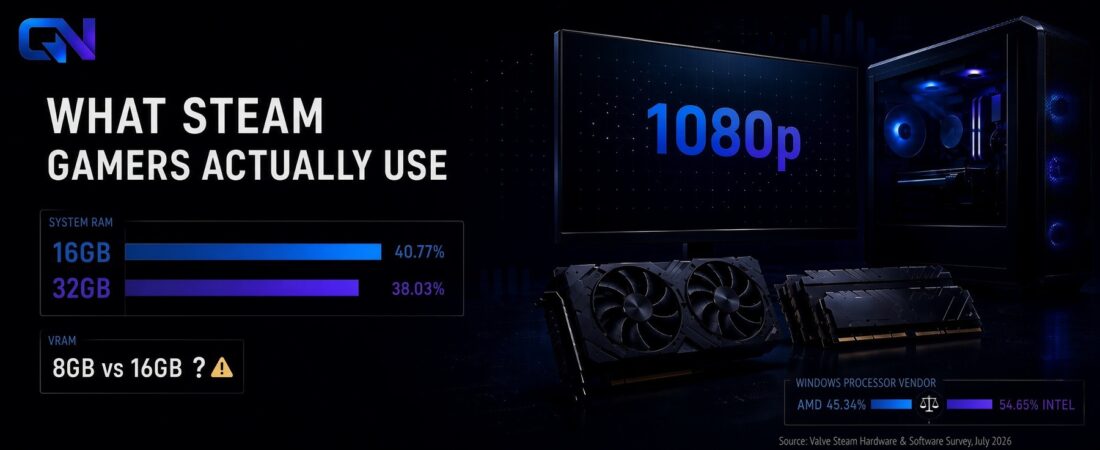
1080p still dominates Valve’s Steam survey, 32GB of RAM is closing in on 16GB and AMD has narrowed Intel’s CPU lead. But look closely at some of the more tempting numbers, especially VRAM, and the story gets messier.
It’s very easy to misuse the Steam Hardware & Software Survey.
Take the most popular entry from every table, bolt them together and you can apparently build the average gaming PC.
July 2026 makes that especially tempting.
1080p is still comfortably the biggest display-resolution category. 16GB remains the most common amount of system RAM, although 32GB is getting very close. AMD now accounts for more than 45% of processors among surveyed Windows systems. And in Valve’s combined Windows, Mac and Linux VRAM table, 16GB has just edged ahead of 8GB.
That sounds like a fairly neat picture of PC gaming in 2026.
It isn’t.
Valve gives us separate distributions for things like resolution, RAM, graphics hardware and processors. It doesn’t show that all the most popular entries belong to the same machines.
More importantly, some numbers change dramatically when you switch between the combined survey and Valve’s platform-specific views.
So rather than trying to invent one typical Steam PC, the more useful question is this: what does Valve’s survey actually tell us about the hardware people are using?
1080p is still the centre of gravity
PC hardware marketing has spent years pushing higher resolutions, faster GPUs and increasingly elaborate monitors.
Steam’s surveyed hardware base is less glamorous.
Across Valve’s combined Windows, Mac and Linux figures, 1920 × 1080 accounts for 51.10% of primary displays.
The next major category is 2560 × 1440 at 21.46%. Native 3840 × 2160, or 4K, sits at 4.95%.
Windows makes the gap wider again:
1920 × 1080: 52.87%
2560 × 1440: 22.08%
3840 × 2160: 5.01%
This doesn’t tell you what people are buying today. Valve doesn’t show when those monitors were purchased, how much they cost or why somebody chose them.
What it shows is the installed base.
And that installed base is still overwhelmingly centred on 1080p.
That matters for more than hardware enthusiasts arguing about monitor upgrades. Developers targeting a broad Steam audience still have to account for a hardware base where 1080p dominates.
1440p is clearly established. 4K is meaningful. Neither is close to replacing 1080p across Steam’s surveyed machines.
32GB of RAM is closing fast on 16GB
System memory looks more like a market in transition.
Among surveyed Windows systems, 16GB remains the largest category at 40.77%.
But 32GB is already at 38.03%.
Only 2.74 percentage points separate them.
It’s tempting to turn that into “32GB is the new standard”, but even overtaking 16GB would only make it the biggest individual category. It wouldn’t mean most Steam PCs suddenly had 32GB.
Valve also can’t tell us why people have that much memory. Some may have upgraded for games. Others may use the same machine for work, content creation or heavier applications. Some simply bought a PC that came with 32GB.
Whatever the reason, the shift is still worth paying attention to. Steam’s surveyed Windows base is no longer built overwhelmingly around 16GB. The split between 16GB and 32GB is now remarkably close.
AMD keeps chipping away at Intel’s lead
Valve’s Windows processor figures tell another interesting story.
In July, Intel accounted for 54.65% of surveyed Windows processors, with AMD at 45.34%.
Back in March, the split was 55.82% Intel and 44.17% AMD.
That means Intel’s lead has narrowed from 11.65 percentage points to 9.31 points in four months.
The movement hasn’t been perfectly smooth. AMD stood at 44.97% in May, slipped slightly to 44.92% in June, then reached 45.34% in July.
So one monthly change isn’t particularly exciting on its own.
The broader direction is.
Among the Windows systems captured by Valve’s survey, AMD and Intel are now much closer than the old image of an overwhelmingly Intel-dominated Steam hardware base might suggest.
Participation is optional and anonymous, and Valve doesn’t give us the kind of methodology detail you’d want for hard market sizing. Treat these figures as a view of Steam’s surveyed population, not a precise measurement of every PC gamer on the planet.
Valve’s CPU table is closer than the headline suggests
Another eye-catching number appears in Valve’s Physical CPUs table.
Across Windows, Mac and Linux combined:
8 CPUs: 27.85%
6 CPUs: 27.52%
So eight has technically moved ahead of six.
Switch to Windows only and it flips:
6 CPUs: 28.43%
8 CPUs: 27.74%
That’s close enough that declaring some major shift from six to eight would be overcooking it.
There’s another reason to be careful. Valve calls this field Physical CPUs, but the public survey page doesn’t give enough detail for us to turn those entries into broader claims about architecture or performance.
So we’ll stick with Valve’s terminology.
The useful point is simpler: six and eight are extremely close, and which one comes first depends on which version of the survey you’re looking at.
VRAM is where the obvious headline falls apart
Then we get to the strangest part of July’s numbers.
Open Valve’s default combined Windows, Mac and Linux survey and the biggest VRAM category is:
16GB: 25.90%
Just behind it:
8GB: 25.32%
You can already imagine the headline.
16GB VRAM is now the Steam standard.
Now switch to Windows.
The picture changes completely:
8GB: 33.20%
12GB: 14.28%
16GB: 11.03%
Among surveyed Windows systems, 8GB is still roughly three times as common as 16GB.
That alone should make anyone cautious about translating the combined figure into a claim about dedicated graphics cards.
Windows, Mac and Linux don’t all handle graphics memory in the same way. Apple, for example, uses a unified-memory architecture on Apple silicon, where the CPU and GPU share the same memory pool rather than using the conventional dedicated VRAM setup you’d expect on a typical discrete Windows GPU.
Valve’s Mac results also look very different. In July, 16GB accounts for 39.34% of its VRAM category, with 8GB at 25.51%.
But we can’t simply point at Macs and say that explains the combined result. Valve doesn’t publish enough detail about the underlying sample, weighting or platform breakdown for us to reconstruct exactly why its combined VRAM table ends up with 16GB on top.
The Linux figures are another reminder not to join separate tables together as if they describe the same individual machines. Valve lists the Steam Deck GPU at 11.14% of Linux video-card descriptions, while its Linux VRAM table has 1GB as the largest category at 25.45%, followed by 8GB at 17.08%.
Those are separate aggregate results. Valve doesn’t tell us which VRAM result belongs to which GPU.
So Valve’s combined 25.90% figure does not show that one quarter of ordinary Steam gaming PCs now have graphics cards with 16GB of dedicated VRAM.
And it certainly isn’t enough to declare 16GB graphics cards the new Steam standard.
If you’re specifically interested in conventional Windows gaming graphics memory, Valve’s Windows-only table is much more useful.
There, 8GB remains comfortably in first place.
There is no single Steam gaming PC
The graphics-card table makes the wider problem obvious.
Valve’s most common individual GPU in the combined July survey is the GeForce RTX 3060 at just 3.71%.
Even number one represents a tiny slice of the whole surveyed base.
That is PC gaming.
One 1080p system might have 8GB of system RAM and an old graphics card. Another might have 32GB and something much newer. A PC connected to a 4K display isn’t automatically running a top-end GPU.
Valve doesn’t give us enough information to combine all of those characteristics into one statistically meaningful machine.
There’s no useful “average Steam PC” hiding in these tables.
Instead, the survey shows a hardware base made up of wildly different systems.
So what is the Steam survey actually good for?
Quite a lot.
Valve describes the Steam Hardware & Software Survey as an optional, anonymous monthly survey of the hardware and software its customers use. The company says the results help guide decisions about technology investments and the products it offers.
For us, its real value is as a view of the installed hardware base.
It can show which categories are common, how those categories are changing and whether broader shifts are starting to appear.
What it can’t tell us is why somebody owns a particular component, when they bought it, how much they paid, what games they play or what they plan to upgrade next.
It also isn’t a census of every PC gamer. It’s a survey of participating Steam customers.
That’s still an extremely useful dataset. You just have to ask it the right questions.
What should you actually take from July’s numbers?
Probably not a shopping list.
1080p being dominant doesn’t mean you should automatically buy a 1080p monitor.
32GB closing in on 16GB doesn’t mean every modern game suddenly needs 32GB of RAM.
And 8GB being the largest Windows VRAM category doesn’t settle whether an 8GB graphics card is a good new purchase for the games you want to play over the next few years.
What people already own and what you should buy today are different questions.
July’s survey is more interesting as a snapshot of just how broad PC gaming still is.
Newer hardware keeps filtering in. 32GB machines are becoming much more common. AMD continues to close the gap with Intel.
Yet more than half of surveyed primary displays are still 1080p, 8GB remains the biggest Windows VRAM category and even Steam’s most common individual graphics card accounts for less than 4% of the combined survey.
PC gaming doesn’t move forward as one neat block.
Old machines stick around. New ones arrive. Laptops, desktops, handhelds, Macs and Linux systems all end up in the mix.
That mess is exactly why Valve’s survey is interesting.
You just have to resist turning it into a cleaner story than the numbers deserve.