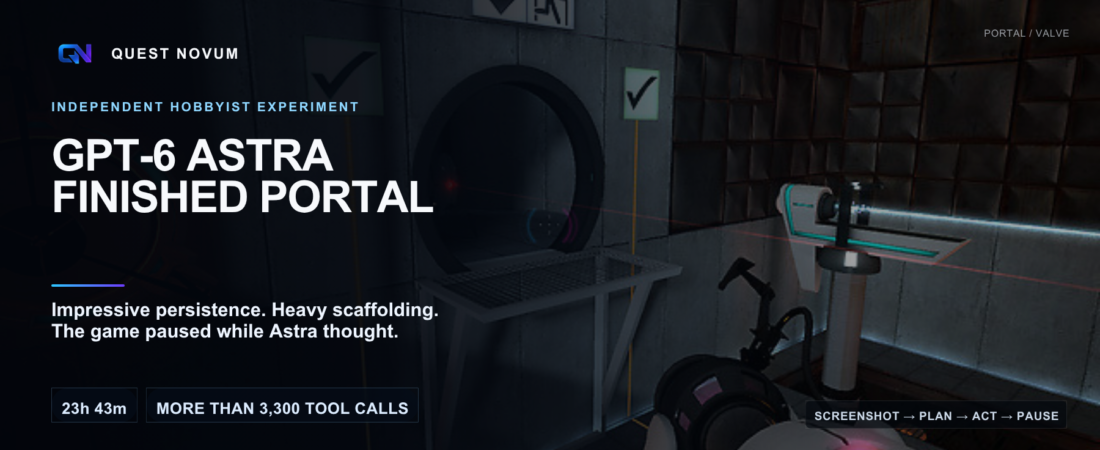
An independent hobbyist setup got OpenAI’s new model to the credits of Valve’s 3D puzzler. The revealing part is how it did it: a paused game, screenshots plus position data, and more than 3,300 tool calls over almost a day.
GPT-6 Astra has finished Portal. The more interesting part is that it needed almost a day, a bespoke control harness and a game that stopped moving whenever the model needed to think.
This was not an OpenAI demonstration. A hobbyist using the name cozyblaze connected OpenAI’s GPT-6 Astra to Valve’s 2007 puzzle game and published the setup plus a sanitised record of the run. The project says the model reached the end credits on 5 September after about 23 hours and 43 minutes from start to completion, including capacity interruptions and waiting.
That is still a notable result. A general-purpose model was able to keep pursuing one objective across a long sequence of visual observations, spatial puzzles, failed attempts and control actions until it reached the end of a 3D game. It did so without the author steering the gameplay after the initial goal, according to the project’s account.
But this was nothing like a person sitting down with a mouse and keyboard and playing Portal in real time. The details of the harness are the story.
What Astra actually saw and controlled
The public repository describes a loop built around Codex, GPT-6 Astra, a local Model Context Protocol server and a modified SourcePauseTool.
Astra received screenshots from Portal together with structured information about the player’s position and facing direction. It then produced a JavaScript plan for the next inputs. The tool let the game run for a specified number of ticks, stopped it again, and returned a fresh screenshot and state information for the next decision.
In other words, the model did not have to continuously watch a moving game and react frame by frame. It could observe, reason, issue a sequence of actions, inspect the result and try again.
The repository says the run used the model identifier gpt-6-astra with max reasoning effort. After capacity errors, cozyblaze resumed the run and switched to Fast mode. The author says the agent handled gameplay throughout; after the initial goal, the only additional instruction was to leave the credits rolling once it had finished.
That is meaningful autonomy, but it is autonomy inside a carefully built interface. The screenshots gave Astra visual information, while the position and facing data removed some of the uncertainty a human player has to resolve by looking at the screen. The custom control tool also let the model express whole input sequences rather than physically operating a controller in real time.
The pause button changes what “playing” means
The single most important caveat is also the simplest: Portal was paused while Astra thought.
When the model issued an input sequence, the game advanced. When Astra needed to reason about the next move, the game stopped. That turns the experiment into a repeated observe-plan-act loop rather than a continuous sensorimotor challenge.
This does not make the achievement meaningless. Portal asks players to understand three-dimensional spaces, use portals to manipulate position and momentum, remember what previous attempts achieved and combine several actions to solve a chamber. A system that can repeatedly inspect a result, update its plan and keep working through the full game is demonstrating more than one-shot image recognition or a scripted sequence.
It does change the comparison with human play. Astra was not under the same time pressure as a person watching a live game state. The nearly 24-hour wall-clock runtime therefore tells us more about long-horizon persistence than about reaction speed.
More than 3,300 tool calls is the real scale of the run
The project’s primary summary records 85,354 seconds from the start of the run to completion, which is 23 hours, 42 minutes and 34 seconds. It also reports roughly 434.8 million cumulative tokens.
The tool-call record needs slightly more care. Secondary reports cite a final tally of 3,336 calls. The current public summary in the repository lists 3,306 calls across its named tool methods, including 3,210 Portal execution calls, 40 screenshot calls and 13 documentation calls. The public evidence does not explain the 30-call difference, so Quest Novum is treating the experiment as a run involving more than 3,300 tool calls rather than claiming to have independently reconstructed the exact 3,336 figure.
The same caution applies to the widely repeated $571.18 cost figure. Tom’s Hardware reports that value for the run, but also says cozyblaze clarified that the usage was covered by a $200 Codex Pro subscription. OpenAI’s public API pricing for Astra charges separately for input, cached input and output tokens, with additional conditions for very large prompts.
So $571.18 is useful as an API-equivalent or token-cost comparison, not as a clean statement that the researcher received a $571.18 bill for this playthrough. Either way, the scale of the token use makes the efficiency gap obvious. Reaching the credits required an enormous amount of repeated context processing compared with the compact interaction loop of a human player.
Portal is a hard game, but not a clean unknown world
There is another reason not to call this a benchmark of general intelligence.
Portal launched in October 2007. Full walkthroughs were being published within days, and the game has since accumulated nearly two decades of guides, videos, wikis and discussion. OpenAI lists Astra’s knowledge cutoff as April 2026.
That does not prove the model memorised Portal’s solutions or relied on a particular walkthrough. It means this experiment cannot cleanly separate fresh spatial reasoning from knowledge the model may already have absorbed about the game during training.
The harness is also bespoke to this task. One model, one game and one custom tool stack do not provide the controlled comparisons, repeatability or held-out environment needed for a standardised benchmark. Cozyblaze has made essentially the same point publicly, describing the run as not a proper benchmark by itself.
The right conclusion is narrower than “AI can now play games like humans”
OpenAI launched GPT-6 Astra on 3 September with its own claims of major gains in computer use and complex multi-step work. The Portal run is separate from those evaluations. OpenAI did not conduct this experiment, and the hobbyist project should not be read as an official OpenAI benchmark or endorsement.
What the run does show is still interesting. Give a frontier general-purpose model visual input, structured state information, a reliable action tool and enough time, and it can maintain a complicated objective through thousands of observe-and-act cycles inside a 3D puzzle game until the objective is complete.
That is exactly the kind of behaviour that matters for useful agents outside games. Many real tasks are not solved by producing one clever answer. They require checking the current state, taking an action, seeing what changed, recovering from mistakes and continuing without losing the goal.
Portal also exposes what remains unfinished. The model needed the world frozen while it reasoned. It received structured position data in addition to images. It consumed hundreds of millions of tokens. The run took almost a day and happened in an environment with a huge public documentation trail. Its exact tool-call accounting is not fully reconciled in the public record.
The next convincing step is not simply another famous game completed with a bigger model. It is the same kind of long-horizon success with less scaffolding, much faster closed-loop control, lower cost and an environment that gives the agent fewer chances to lean on prior knowledge.
Astra reaching Portal’s credits is a real demonstration of progress. The gap between that and human-like autonomous play is visible in the same evidence that makes the demo impressive.