ChatGPT can use the subject of your conversation — and, with personalisation enabled, past chats and memory — to help choose an advert. OpenAI says that does not mean the advertiser gets to see those conversations. Here’s what UK users need to know.
OpenAI now says ChatGPT Ads has launched in the UK, bringing advertising to eligible British users on the Free and Go plans.
But this is not a 12 August launch.
OpenAI announced plans to expand its US advertising test to the UK in May, and its ChatGPT release notes show that the UK rollout began on 4 June 2026. On 11 August, OpenAI updated its advertising announcement to say ChatGPT Ads had now launched in the United Kingdom, alongside Mexico, Brazil, Japan and South Korea.
The more interesting question is not simply whether an advert can appear underneath a ChatGPT response. It is how OpenAI says that advert can be selected.
The subject of the conversation you are having can influence which advert appears. With personalised advertising enabled, OpenAI says previous chats, memory and earlier interactions with ads can also contribute.
That might sound as though the advertiser gets access to what you have been saying to ChatGPT.
OpenAI says it does not work that way.
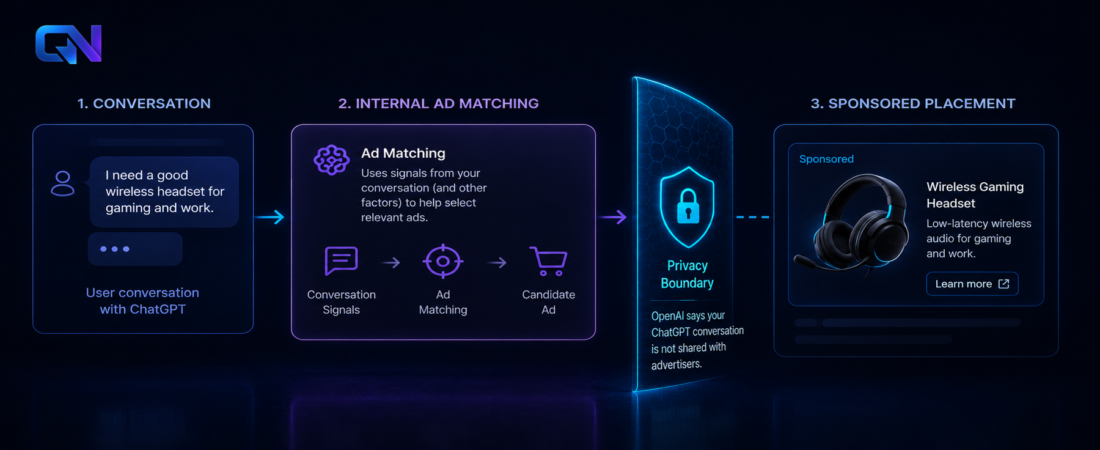
According to its current documentation, the information used to make an advert relevant stays within ChatGPT. OpenAI says advertisers do not receive users’ chats, chat histories or memories and instead receive aggregated performance information such as overall views and clicks.
That distinction — your conversation can help choose the advert without the advertiser being given the conversation — is the part worth understanding.
Which ChatGPT plans can receive ads?
OpenAI says ads may appear for users on the Free and Go plans.
Plus, Pro, Business, Enterprise and Edu accounts remain ad-free.
The adverts themselves are also separate from ChatGPT’s answers. OpenAI says its advertising system runs separately from the chat model and that advertisers cannot shape, rank or alter the responses ChatGPT gives. Ads appear below responses and are labelled as sponsored.
So there are two different processes involved.
ChatGPT generates the answer.
A separate advertising system decides whether there is an eligible sponsored placement to show alongside it.
The fact that conversational context can inform both does not, according to OpenAI, mean an advertiser has bought influence over the answer.
Why might you see a particular advert?
Even without broader advertising personalisation, OpenAI says the current chat thread can be used to make an advert more relevant.
Basic context such as language and general location can also be considered.
If personalised ads are enabled, OpenAI says additional signals can include:
- the current conversation, including personalised model responses;
- how you interact with adverts, such as those you hide or engage with;
- past chats;
- memory, where the relevant memory settings are enabled.
This makes advertising inside a conversational AI product different from simply placing an advert next to a conventional web page.
A conversation can reveal what somebody is trying to achieve in considerably more context than a single search phrase.
The important privacy question is therefore what happens to that context next.
What does the advertiser actually know about you?
OpenAI says advertisers do not receive your ChatGPT conversations, chat history or memories.
Its current Help Centre also says advertisers do not receive your name, email address, precise location, IP address or sensitive information such as health, mental-health or political information through ChatGPT’s ad-selection process.
Instead, OpenAI says advertisers currently receive aggregated reporting about how their adverts perform, including measurements such as views and clicks.
So if you are discussing a holiday with ChatGPT and subsequently see a travel advert, OpenAI’s stated model is not that the travel company has been handed your conversation.
The matching happens inside ChatGPT.
There is one obvious exception: if you deliberately choose to message an advertiser through an advert, the advertiser can see the messages you send directly to it.
Advertisers can also separately use customer or prospect information they already possess, such as email addresses or phone numbers, to build large Custom Audiences for their campaigns. That is different from OpenAI supplying them with your ChatGPT conversations or memories. OpenAI says its Ads Manager does not expose individual matched users to the advertiser.
What happens if you turn personalised ads off?
Turning personalisation off is not the same as turning advertising off.
OpenAI says the context of your current chat thread can still be used to choose adverts after broader ad personalisation is disabled.
What changes is that other chat threads, advertising history and other personalisation signals are no longer used in the same way to inform what you see.
OpenAI also documents controls for clearing data used for advertising, seeing why an advert appeared, hiding or reporting adverts, and controlling whether past chats and memory contribute to ad relevance. Deleted advertising data stops being used for ad selection, although OpenAI says it can remain on its systems for up to 30 days before removal.
There is, however, an important wrinkle for UK users.
OpenAI’s current Help Centre documentation appears internally inconsistent about the regional availability of some Ad Controls.
One part of the documentation describes Ads Controls as dependent on region and eligibility and explains options such as personalisation, past chats and memory. Another current rendering still says Ad Controls are only available to Free and Go users in the US, despite OpenAI separately stating that ads themselves are now rolled out in the UK.
Without clearer documentation, it would be unsafe to promise that every eligible UK account will currently see every control in exactly the same place.
The useful distinction remains: OpenAI says these controls exist, but their availability can vary by region and account.
Can you use ChatGPT Free without ads?
OpenAI also documents an Ads-Free option for the Free plan.
It removes advertising without requiring a paid subscription, but it comes with a trade-off: lower usage limits and reduced feature access.
OpenAI says users should expect fewer messages before hitting limits and may lose access to some tools, giving image generation and deep research as examples.
That makes it different from upgrading to Plus or Pro, which remain ad-free without imposing the reduced Free-plan limits associated with the Ads-Free option.
OpenAI also says Ads-Free is specifically a Free-plan option. A Go subscriber would need to move back to Free to use it, or upgrade to an already ad-free plan such as Plus or Pro.
Again, OpenAI says availability can vary by region and eligibility, so UK users should not assume the option will necessarily appear on every account immediately.
What about sensitive conversations and users under 18?
OpenAI says ads are not eligible to appear alongside sensitive or regulated conversations, including discussions involving personal health, mental health or politics.
Its more detailed advertising policies describe a broader set of contexts where ads should not be placed, including vulnerable user interactions and other material considered unsuitable for advertising.
That is a placement restriction, which is different from saying every business operating in a regulated field is prohibited from advertising.
OpenAI currently says some advertisers in areas such as health or financial services may be considered under additional restrictions, while political advertising remains prohibited.
OpenAI also says ads do not appear in accounts where somebody tells it — or its systems predict — that the user is under 18. Its age-prediction documentation says accounts predicted to belong to somebody under 18 can be placed into a teen experience in which advertising is not shown.
That does not mean OpenAI can identify the age of every user perfectly. The confirmed claim is narrower: accounts it identifies as belonging to under-18s are not shown ads.
Temporary Chats also do not show advertisements.
What should UK ChatGPT users actually know?
If you are using Free or Go, you may receive ads. Plus, Pro, Business, Enterprise and Edu remain ad-free under OpenAI’s current documentation.
The advert you see can be influenced by what you are discussing in the current conversation.
With personalised advertising enabled, OpenAI says past chats, memory and previous interactions with adverts can contribute too.
That does not, according to OpenAI, mean the advertiser gets access to those conversations or memories. The company says the contextual matching occurs within ChatGPT and that advertisers receive aggregated advertising-performance information rather than users’ conversations.
Turning off personalisation changes which information can be used to tailor advertising, but it does not necessarily remove adverts altogether. OpenAI also documents a free Ads-Free option with substantially reduced limits, while its paid ad-free plans remain another option.
The unresolved part for UK users is less about the principle than the controls themselves: OpenAI currently says ads are rolled out in Britain, but its Help Centre is not yet fully consistent about which advertising settings are available in which regions.
That is worth watching because the important issue with conversational advertising is not simply whether a sponsored box appears beneath an answer.
It is how much context is used to decide what goes inside that box, where that information stays, and how much control the person having the conversation actually has over the process.