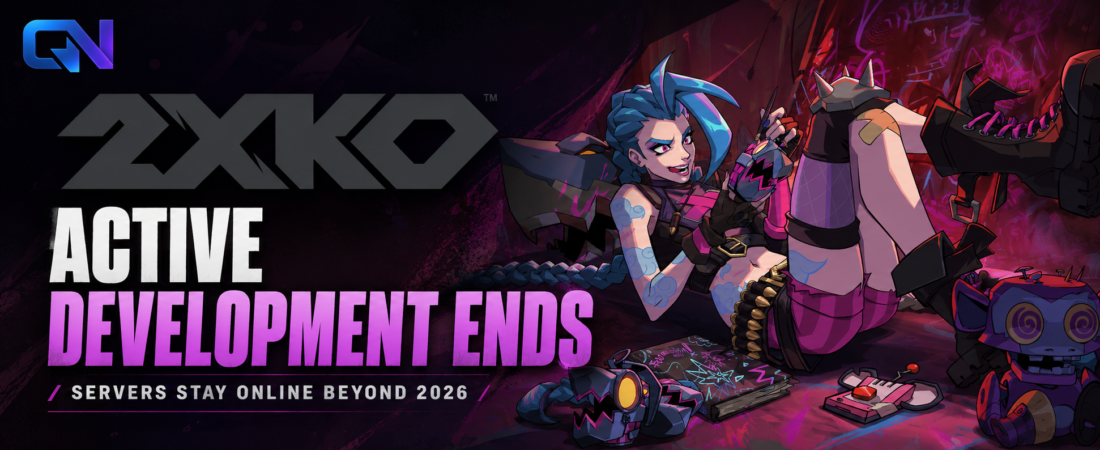
2XKO is not shutting down, but Riot will end active development at the end of 2026 after concluding that too few players were sticking with its free-to-play League fighting game to make continued development sustainable. Riot Games
Six months ago, Riot cut the size of the team behind 2XKO.
The reason was already uncomfortable. The League of Legends fighting game had found a passionate core audience, but Riot said its momentum was not high enough to support a development team of that size long term. The smaller team was supposed to give 2XKO a “more sustainable path forward”. Riot Games
Now we know that path did not work.
Riot says active development of 2XKO will end at the end of 2026. The game itself is not disappearing. Servers will remain online beyond this year, offline play is unaffected and 2XKO will remain downloadable on PC, PlayStation 5 and Xbox Series X|S. Riot Games
But the live-service version of 2XKO is effectively being wound down.
And Riot is unusually direct about why.
It did not retain enough players.
Free-to-play got people through the door. It did not make enough of them stay
2XKO had some advantages most new fighting games would happily take.
It was free to play. It started on PC before expanding to PlayStation 5 and Xbox Series X|S in January 2026. Its roster drew from recognisable League of Legends and Arcane characters, and it had Riot behind it with years of experience running competitive online games. 2XKO
Riot’s plan was explicitly to use free-to-play to make fighting games more accessible and discoverable, then grow from a core fighting-game audience as more features and content arrived. Riot Games
There was always a catch.
Riot says it went into the project knowing from the start that free-to-play came with a minimum player requirement if 2XKO was going to support those ambitions. Riot Games
People did try 2XKO. Riot says plenty of players jumped in, and a committed community still plays every day.
The problem was what happened afterwards.
Riot says it has not seen enough players stick with the game to create a sustainable path. It also says that even within fighting games, dedicated tag-fighter players embraced 2XKO more strongly than much of the wider audience, which struggled to find enough reasons to keep playing. Riot Games
That distinction matters.
A free game can remove the price barrier. A famous licence can generate interest. Neither guarantees retention.
For a live-service game, getting someone to download it is only the beginning of the economic problem.
Riot already knew something was wrong in February
The August decision did not come from nowhere.
On 9 February, Riot announced it was reducing the 2XKO team after seeing consistent engagement trends as the game expanded from PC to console. Riot Games
Its language at the time was cautious but clear: overall momentum had not reached the level required to support the existing team long term. Riot’s proposed answer was a smaller, focused group making improvements while preserving the competitive programme. Riot Games
There were gameplay problems Riot wanted to tackle too.
In January, game director Shaun Rivera acknowledged that 2XKO’s flexible systems could feel too sharp and overwhelming for some players. Riot planned significant changes aimed at getting players back into the action faster and making interactions more intuitive. It was also investing further in its distinctive duo-play system and community competition. 2XKO
Then came more champions, larger updates, a PvE mode and competitive events.
None of them changed the underlying trajectory enough.
Riot says it evaluated retention, new players, engagement and revenue throughout 2026. Releases including Akali, Senna, Thresh and The Climb produced positive moments, but no meaningful sustained shift followed. Riot Games
That makes the February reduction more significant in hindsight.
Riot had already tried cutting the cost side of the equation while continuing to improve the game.
Six months later, it concluded the equation still did not work.
This is an economic decision, not just a player-count story
Riot has not published 2XKO’s exact player numbers, development budget or revenue.
There is no need to invent them.
Its own explanation is much more useful.
Riot says 2XKO costs substantially more to operate than it brings in, while engagement has remained relatively flat despite larger updates. It considered reducing the team further, slowing the patch schedule and changing the business model before deciding that completing its existing work and ending active development was the better option. Riot Games
That is the key to understanding what happened.
2XKO did not need literally nobody playing it to become unsustainable.
It needed enough persistent players to justify the cost and ambition of continuing to build a live-service fighting game.
Riot says it did not have them.
There is still an active community. There were tournament organisers running the game. New champions, modes and events created moments of renewed interest.
They were simply not enough to create the sustained change Riot needed to see.
That is a much harder problem to solve than launch awareness.
Riot is dismantling the live-service machinery, not switching the game off
The September update will substantially simplify how 2XKO works as an ongoing online game.
All champions will become available to all players. Battle Passes, KO Points, Champion Tokens, seasons and events are being removed.
Ranked lobbies are going too.
Riot says Casual lobbies will continue to use skill-based matchmaking, while removing Ranked allows matchmaking to operate through a single player pool per server. Private lobbies remain. Riot Games
Lux arrives in September, followed by Samira in October. Samira will be 2XKO’s final new champion, and October’s patch will be the game’s final major content update. Riot may release one final bug-fix patch in December. Riot Games
After that, the servers stay on.
This is therefore not a conventional shutdown announcement.
Riot is preserving 2XKO as a playable fighting game while removing the systems and development commitments required to keep treating it as a growing live service.
Players are getting their money back too
Riot has stopped selling KO Points and is refunding purchases made before the announcement.
On PC, Riot says KO Point and Starter Edition purchases made before 20 August will be returned to the original payment method. PlayStation and Xbox refunds will be handled through their respective platforms and payment providers, with separate processes for Japan and Korea. Riot Games
Players keep content they already own.
Riot will also unlock all champions and make more cosmetic and profile content obtainable through Credits earned in the game. Riot Games
It is an unusually generous ending to the commercial experiment.
It is also an acknowledgement that the commercial experiment is ending.
2XKO’s problem was not getting noticed
It would be easy to stretch 2XKO into another story about live-service games failing.
The evidence here does not need that.
2XKO tells a narrower and more useful story.
Riot built a free-to-play game around one of gaming’s biggest pools of recognisable characters. It expanded from PC to consoles, invested in competitive events and continued adding champions, modes and features.
That was enough to produce attention and a committed community.
It was not enough to produce the sustained retention required by the business model.
And Riot had already tried shrinking the operation once.
The important lesson is that free-to-play can solve the question of “will people try this?” without solving the much harder question of “will enough people still be here months later?”
For an expensive live-service game, the second question is the one that matters.
Riot gave 2XKO another six months to find a sustainable answer.
It didn’t.