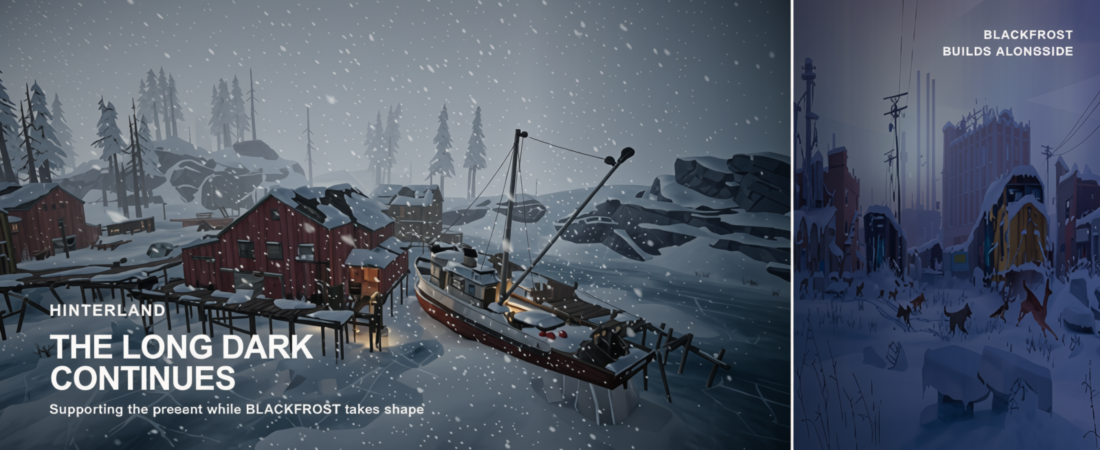
Hinterland already used revenue from The Long Dark to fund its future. Now, as Raphael van Lierop says new-game launches have become less predictable, the studio is shifting some people back to its proven survival game, planning more than two years of additional support and keeping BLACKFROST on a leaner self-funded path.
The most revealing part of Hinterland’s latest update is not that BLACKFROST: The Long Dark 2 is now aiming for Early Access in 2027.
It is that some of the people working on the sequel have moved back onto The Long Dark.
Hinterland founder Raphael van Lierop says a dedicated BLACKFROST team is still active, refining the sequel’s core systems and world. But the studio is deliberately putting more emphasis on the game it already knows can attract players and generate revenue.
The Long Dark now has at least 24 more months of planned development ahead of it. Hinterland intends to keep updating the core Survival sandbox, while also building two paid DLC workstreams. Van Lierop says revenue from The Long Dark and its DLC is how the independent studio will continue funding both the company and BLACKFROST.
That funding model is not new. The important change is how heavily Hinterland now intends to lean on it.
The funding model was already there
In April 2025, van Lierop gave an unusually direct explanation for why Hinterland could not simply finish The Long Dark, disappear for several years and emerge with a sequel.
The studio pays its annual costs from revenue generated by The Long Dark and DLC such as Tales from the Far Territory. Without a publisher, parent company or outside development funding covering the gap between releases, Hinterland needs its existing work to keep earning while new projects are being built.
That was already the logic behind continuing to update The Long Dark alongside BLACKFROST.
It was also about keeping the audience connected. Van Lierop argued that a sequel becomes harder to launch if a studio loses contact with its players for years, so maintaining The Long Dark could keep both revenue and community attention alive while BLACKFROST moved towards Early Access.
At the time, however, he also expected the balance gradually to move the other way, with a larger proportion of Hinterland’s time and resources eventually shifting towards BLACKFROST.
The August 2026 plan is a meaningful recalibration of that trajectory.
What changed is the balance
Van Lierop says the games market looks substantially less predictable than it did when BLACKFROST was announced in December 2024.
His diagnosis is broad. He points to disrupted business models, economic and geopolitical uncertainty, questions around future console hardware, and players spending more of their limited time and money on games they already know, large long-running titles, backlogs and discounted purchases.
Those are van Lierop’s reasons for changing Hinterland’s approach, not proof that every independent studio faces the same conditions.
What matters here is the decision those concerns have produced.
Hinterland now plans three parallel streams of The Long Dark work for the coming 24+ months. One, called TLD Core, will focus largely on free updates to Survival Mode, including bug fixes, quality-of-life work and planned features such as mod support and expanded custom settings. The other two streams are paid DLC projects, with at least one intended to follow a structure similar to the Tales from the Far Territory expansion pass.
The details are still being finalised, but the strategy is already clear enough. Hinterland wants to make its proven game more useful to existing players, create new reasons for people to return or buy in, and generate sustainable revenue while the sequel continues in parallel.
Van Lierop describes The Long Dark and its community as the “lifeblood” of Hinterland’s business. The new plan makes that role more central.
BLACKFROST is still active, but the team is leaner
The resource shift needs to be read carefully.
Hinterland has not said BLACKFROST is abandoned, paused or fully pushed onto the back burner. Van Lierop explicitly says the opposite.
A dedicated sequel team remains in place. Some internal staff have moved from BLACKFROST to The Long Dark’s core and DLC work, leaving what he calls a lean and focused team to continue developing the sequel.
BLACKFROST is currently planned for Early Access in 2027. Hinterland also says it is working towards showing the first gameplay before the end of 2026, followed by continuing development updates. That reveal is a plan rather than a guarantee, and 2027 remains a window rather than a precise launch date.
There are creative reasons for the slower approach too. Van Lierop says building a sequel to The Long Dark has been harder than expected because the team is trying to preserve what works about the original while meaningfully advancing its survival design. He also says the studio is wary of getting that balance wrong with an established audience.
So the current BLACKFROST schedule should not be reduced to one business explanation. The 2027 Early Access move had already been announced before this August resource shift was detailed.
What the new plan shows is how Hinterland intends to manage the risk around that development period.
Independence has a price
Hinterland has considered another route.
Van Lierop says publishers and other potential funding partners have shown significant interest in BLACKFROST since its announcement. With the industry becoming less stable, he says the studio thought it was sensible to consider outside funding rather than automatically carrying the full financial burden itself.
It has not taken that route.
Hinterland says it has not found a partner it believes is sufficiently aligned with the studio’s independence and the interests of its players. Van Lierop also expresses concern about the influence outside funders can exert over developers during an unstable market.
He does not publicly document specific rejected contract terms or demands, so there is no basis for inventing them.
The outcome is what matters: BLACKFROST remains self-funded and self-published.
That makes The Long Dark’s continuing revenue strategically valuable in a way that goes beyond keeping an older game profitable. It gives Hinterland development runway without requiring the studio to accept an external deal it does not currently want.
Every sale or successful DLC does not translate neatly into a particular BLACKFROST feature, and Hinterland has not published the sequel’s budget or the exact share of company revenue coming from each product.
But the company itself is explicit about the relationship. Money generated by the work it has already shipped helps finance the work it has not shipped yet.
A proven game can be more than a back catalogue
For a mature game, another two years of support can easily look like ordinary live maintenance.
For Hinterland, it is becoming part of the financing strategy for its next major game.
The Long Dark already has the things BLACKFROST does not yet have: a released product, an established audience, known demand, DLC history and the ability to generate revenue now rather than after another development cycle.
In a market van Lierop considers harder to predict, those qualities reduce how much Hinterland has to depend on one future launch working exactly as hoped.
There is still risk in the model. Additional DLC has to be worth buying. Free updates still cost money to build. Moving people between projects creates trade-offs, and a leaner BLACKFROST team still has to deliver a sequel capable of satisfying players who may have spent a decade with the original.
But Hinterland has something many new projects do not: an existing game strong enough to keep doing economic work long after its original launch.
That changes what “supporting The Long Dark” means.
The old game is not simply being kept alive while the real future happens elsewhere. It is increasingly the platform from which Hinterland is trying to build that future without giving up control of it.