
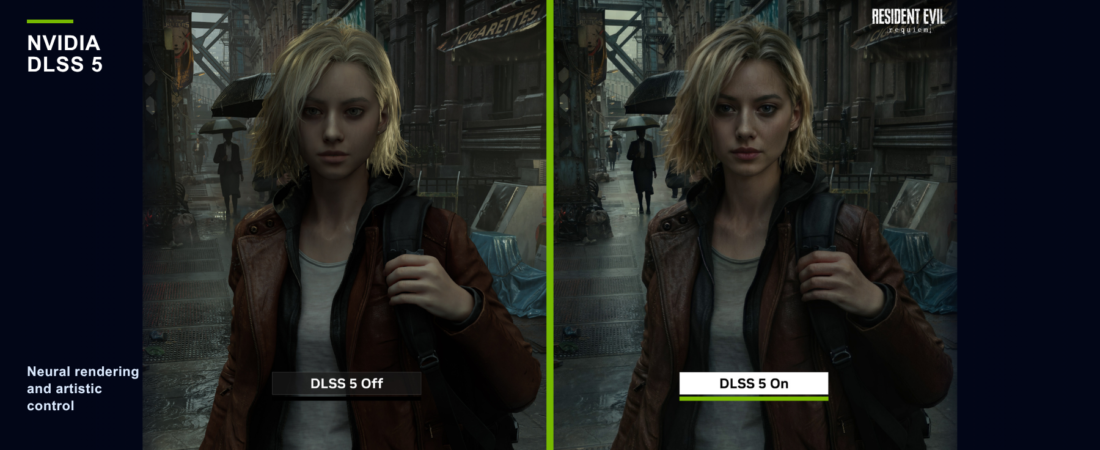
Modders have forced an unofficial pre-release DLSS 5 neural-rendering component into games it was never designed for, producing striking changes to characters, materials, lighting and performance. That does not tell us how finished DLSS 5 will behave, but it makes Nvidia’s emphasis on developer control much easier to understand.
The most useful thing about the leaked DLSS 5 experiments is not that modders have managed to get a future Nvidia feature running early.
It is how quickly neural rendering can make a familiar game look like it was art-directed by somebody else.
An unofficial pre-release Nvidia neural-rendering component reportedly surfaced in the PC early-access files for NBA 2K27. Modders first forced it into Control and have since experimented with it in games including Skyrim, Cyberpunk 2077 and GTA V.
None of those games were built for this implementation of DLSS 5.
That is exactly why the results are interesting.
Faces can change noticeably. Materials can take on different qualities. Lighting and shadows can be reinterpreted. The same scene can become more detailed or more photorealistic while also moving away from how its developers originally chose to make it look.
That does not make these experiments a preview of finished DLSS 5 quality.
It does show why neural rendering has a problem traditional graphics settings do not have to the same degree: better-looking pixels are not automatically the right pixels for a particular game.
DLSS 5 is doing more than sharpening an image
DLSS has spent years being associated with performance.
Super Resolution reconstructs a higher-resolution image from fewer rendered pixels. Frame Generation creates additional frames. Ray Reconstruction uses AI to replace conventional denoisers in ray-traced rendering.
DLSS 5 pushes into more subjective territory.
Nvidia says its neural-rendering model takes a game’s colour and motion information and uses AI to add photoreal lighting and material detail while remaining anchored to the underlying 3D scene.
The model is designed to understand things such as skin, hair, fabric, translucent materials and different lighting conditions.
That means it is not simply deciding whether an edge should be slightly cleaner.
It can influence how a face is shaded, how cloth catches light, how skin responds to illumination or how a shadow contributes to the mood of a scene.
Those are artistic decisions as much as technical ones.
The unsupported experiments make that distinction unusually visible because the technology is being dropped into games without the careful integration their original artists would normally provide.
The leaked version is already changing familiar games
The first widely reported experiments focused on Control, where modders were able to apply the leaked neural-rendering component to character models.
Further experiments have spread to other games, with reporting showing changes to faces, textures, materials, lighting and shadows.
Some results look more detailed. Others look uncanny or simply different.
That last word matters.
A neural renderer can produce an image that looks technically sophisticated without necessarily producing the image the developer wanted.
A worn face might become smoother or more heavily shaded. A material can suddenly read differently under the same lighting. A deliberately stylised character might be pushed towards a more photoreal treatment.
There is no reason to assume those changes represent how Nvidia, Remedy, Rockstar, Bethesda or CD Projekt would choose to integrate the finished technology.
These are unsupported experiments using pre-release software in games that were never authored around it.
Treating them as a finished DLSS 5 comparison would be like judging a graphics engine from a half-configured developer build.
Nvidia’s controls suddenly make a lot more sense
When Nvidia announced DLSS 5 in March, artistic control was already central to its pitch.
The company said games need generated pixels to remain predictable and grounded in the developer’s 3D world and artistic intent.
More importantly, Nvidia says developers will get controls for intensity, colour grading and masking.
Those sound like implementation details until you see what happens when neural rendering is applied without a game’s artists directing it.
Intensity gives developers control over how strongly the model changes the image.
Colour grading helps keep its output aligned with the visual character of the game.
Masking lets artists determine where enhancements should and should not be applied.
That could mean using neural rendering aggressively on one material while protecting another. A studio could potentially enhance skin or fabric without letting the model interfere with a deliberately stylised object, character or part of the scene.
Nvidia’s official proposition is therefore very different from simply switching the technology on globally and asking whether the resulting screenshot looks more realistic.
The developer is supposed to decide where realism helps.
RTX 40-series experiments are impressive, but prove little about support
The modding work has moved quickly.
Tom’s Hardware says it independently verified that the leaked component could be made to run on RTX 40-series hardware after incompatible CUDA instructions were patched for the older Ada architecture.
That is technically interesting.
It is not an Nvidia support announcement.
A modder getting pre-release code to execute on an RTX 4080 or RTX 4090 does not tell us what hardware Nvidia will officially support, what performance targets it considers acceptable or how the finished model will be packaged.
The same caution applies to the early performance numbers.
Tom’s Hardware reported one Control experiment where an RTX 5070 Ti running at 4K fell from 71fps to 35fps with neural rendering active on character models.
That is a substantial hit.
It is also an unofficial implementation of pre-release software inserted into a rendering pipeline it was not designed around.
Those numbers tell us the current experiment can be extremely expensive. They do not establish the performance cost of a properly integrated final release.
These are bad benchmarks, but useful experiments
There is a temptation to treat the leak as an early verdict on DLSS 5.
It is not.
The software is pre-release. The integrations are unsupported. The games were not designed around it. Modders are working without the developer-side implementation Nvidia intends studios to use.
Performance could change significantly.
Image quality could change significantly.
The way developers apply it could change almost everything about the final presentation.
But that does not make the experiments worthless.
They are revealing something more basic about neural rendering.
When AI starts generating material and lighting detail rather than simply reconstructing an image, the question stops being only “does this look better?”
It becomes “better according to whom?”
A technically impressive result can still be wrong for the scene.
Neural rendering needs an art director
That may end up being the most important lesson from this leak.
Nvidia has spent much of the DLSS era selling improvements that players can evaluate relatively easily: higher frame rates, cleaner reconstruction, better ray tracing or smoother motion.
DLSS 5 asks developers and players to accept something more interpretive.
The AI is helping decide how the final image should look.
That makes performance and image quality important, but it also makes restraint important.
The leaked experiments do not prove Nvidia has solved that problem. They certainly do not prove that finished DLSS 5 will preserve every game’s intended look perfectly.
What they do provide is an accidental demonstration of why the controls Nvidia keeps talking about are necessary in the first place.
Neural rendering can change much more than sharpness.
If it is going to become part of how games are rendered, the artists still need to be the ones deciding what should change.