
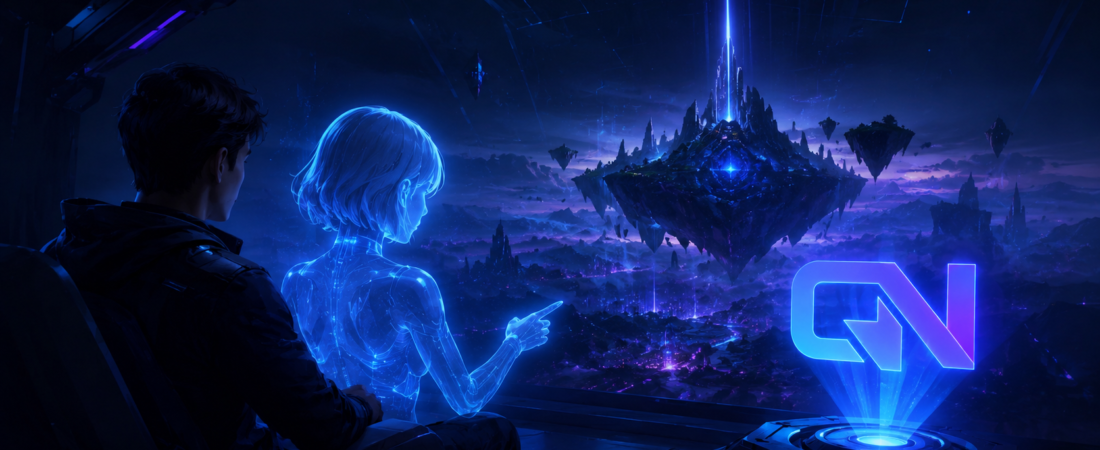
Games have been using artificial intelligence for decades. But the next shift could be fundamentally different.
Instead of AI controlling enemies behind the scenes or helping developers build assets faster, a new generation of games is beginning to put generative AI directly into the experience — shaping conversations, characters and potentially even the way a game responds to the player.
These are increasingly being described as AI-native games. And while the technology opens up some fascinating possibilities, there is a much more important question than whether developers can build them:
Will they actually be fun to play?
What makes a game AI-native?
There is an important distinction between a game that uses AI during development and one where AI is part of the game itself.
Researchers studying 53 publicly available AI-native games and prototypes describe generative AI as integral to the core experience. In simple terms, take the generative AI away and something fundamental about how the game works disappears.
That could mean characters capable of responding dynamically to players, worlds that react in less predictable ways, or systems where generated content becomes part of the actual mechanics rather than simply a faster way of producing assets.
That’s a much more interesting proposition than using AI to generate another background texture or line of dialogue before a game ships. Here, the technology has the potential to change what the player can actually do.
The experiments are already becoming real
KRAFTON has been developing PUBG Ally, an AI-powered companion designed to play alongside a human player in PUBG: Battlegrounds. Built using NVIDIA’s ACE technology, the system combines traditional game AI with a language model capable of reasoning, conversation and contextual awareness.
The interesting part isn’t simply that you can talk to it. PUBG Ally is intended to understand situations within the game and act on them — finding items, sharing loot, driving vehicles and responding to instructions while playing alongside you.
Microsoft and Inworld AI have also been developing tools aimed at bringing generative AI deeper into games. Their partnership includes a runtime character engine designed to enable dynamically generated stories, quests and dialogue during play.
On paper, that sounds transformative. In practice, it creates an entirely new design problem.
Infinite possibilities don’t automatically make a better game
Games work because they have rules. Players understand what they can do, the game responds consistently, and good design creates a satisfying relationship between challenge, choice and reward.
Generative AI introduces unpredictability into that equation.
An NPC capable of discussing almost anything might sound more advanced than one with a fixed dialogue tree, but more dialogue isn’t necessarily better dialogue. A quest that can be generated endlessly isn’t automatically more interesting than one deliberately designed around a memorable character, location or decision.
That’s the challenge AI-native games have to solve. The technology can’t just produce more content. It needs to create better possibilities for play.
The real opportunity is games that couldn’t exist before
The most interesting future for AI in games probably isn’t replacing writers, artists or level designers with machines that generate more content.
It’s creating experiences that would have been impractical to build using traditional systems.
Imagine a detective game where suspects can respond naturally to questions you invent rather than choosing from four dialogue options. A strategy game where rival leaders remember previous negotiations and adapt to the way you play. Or an RPG where characters react convincingly to decisions the developers could never have scripted individually.
Those ideas matter because AI changes the mechanics of the game — not because somebody generated another thousand quests.
There are obvious problems still to solve. Developers need to control what these systems can say and do. Generated content needs to remain consistent with the game’s world. Running AI models has a computational cost. And perhaps most importantly, developers still need to make sure the experience is actually enjoyable.
AI can create unpredictability. Game designers still have to turn that unpredictability into play.
The technology isn’t the game
We’ve seen this cycle before. New technology arrives, impressive demonstrations follow, and suddenly it feels as though every game needs it.
Most don’t.
AI-native gaming will matter when developers stop treating AI itself as the feature and start using it to create experiences players couldn’t previously have.
PUBG Ally and today’s experimental AI characters are early steps rather than proof that this future has been solved. Some experiments will be gimmicks. Some will probably be terrible. But eventually someone will build a game where removing the AI would fundamentally break what makes it special.
That’s the game worth watching for.
Until then, the question isn’t whether AI can change gaming.
It’s whether it can make games better.